
Introduction
Every business needs customers to grow. But before someone becomes a customer, they usually go through several stages. They may discover your brand, visit your website, follow you on social media, read your content, or contact your business before finally making a purchase.
This is where lead generation becomes important.
Lead generation is the process of attracting people who may be interested in your products or services and encouraging them to provide their contact information or take a valuable action. These people are called leads.
For example, someone visits your website and fills out a contact form to ask about your digital marketing services. That person can become a lead.
Lead generation is an important part of digital marketing because it helps businesses build relationships with potential customers instead of relying only on random website visitors.
In this beginner-friendly guide, you will learn what lead generation is, how it works, different types of leads, lead generation strategies, tools, common mistakes, and how to create a simple lead generation system for your business.
What Is Lead Generation?
Lead generation is the process of attracting potential customers and encouraging them to show interest in a business, product, or service.
A lead can be someone who:
- Fills out a contact form
- Requests a quote
- Subscribes to an email newsletter
- Downloads an ebook
- Books a consultation
- Calls a business
- Sends a message
- Registers for a webinar
- Creates an account
- Requests product information
The goal of lead generation is not necessarily to make an immediate sale.
Instead, the goal is to identify people who may have a genuine interest in what your business offers and move them toward becoming customers.
What Is a Lead?
A lead is a person or organization that has shown some level of interest in your business.
For example, imagine you run a website design agency.
A visitor comes to your website and reads your services page. They then complete a form saying:
“I need a website for my business. Please contact me.”
That visitor is now a potential lead.
However, not every lead has the same level of interest.
Some people may be ready to buy immediately, while others may simply be researching their options.
This is why businesses often classify leads based on their level of interest and buying readiness.
Why Is Lead Generation Important?
Lead generation is important because businesses need a consistent way to attract potential customers.
Without lead generation, a business may depend heavily on:
- Word-of-mouth referrals
- Random website visitors
- Existing customers
- Walk-in customers
- Unpredictable sales opportunities
A structured lead generation strategy can create a more consistent flow of potential customers.
Benefits of lead generation include:
- More potential customers
- Better sales opportunities
- Increased brand awareness
- Improved customer relationships
- Better marketing measurement
- More predictable sales processes
- Opportunities for long-term growth
For small businesses, lead generation can be especially useful because it allows them to focus marketing efforts on people who have shown interest.
How Does Lead Generation Work?
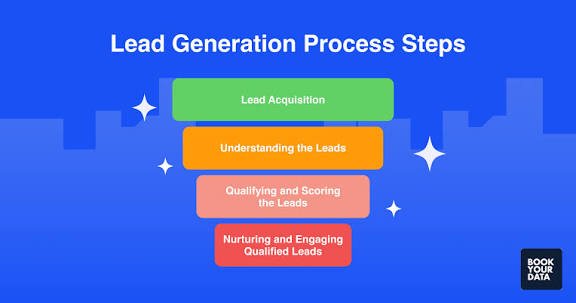
A basic lead generation process can be divided into several steps.
Step 1: Attract
First, you attract potential customers through channels such as:
- Google Search
- SEO
- Social media
- Google Ads
- Meta Ads
- YouTube
- Email marketing
- Content marketing
- Referrals
Step 2: Engage
Once people discover your business, provide useful information that keeps them interested.
Examples include:
- Blog posts
- Videos
- Guides
- Case studies
- Social media content
- Free resources
Step 3: Capture
Give visitors an opportunity to provide their information.
For example:
“Get Your Free Website Audit”
The visitor clicks the button and fills out a form.
Step 4: Qualify
Not every lead is equally valuable.
You can evaluate leads based on factors such as:
- Need
- Budget
- Location
- Business type
- Purchase timeline
- Service requirements
Step 5: Nurture
Some leads are not ready to purchase immediately.
You can continue communicating with them through:
- Educational content
- Follow-up messages
- Webinars
- Product demonstrations
Step 6: Convert
Eventually, qualified leads may become customers.
Types of Leads
Understanding different types of leads can help businesses create better sales and marketing strategies.
1. Cold Leads
Cold leads have limited awareness or interaction with your business.
They may fit your target audience but have not shown strong buying intent.
For example, someone who sees your social media advertisement for the first time could be considered a cold prospect.
2. Warm Leads
Warm leads have already interacted with your business.
They may have:
- Visited your website
- Followed your social media account
- Downloaded content
- Watched your videos
- Subscribed to your email list
They may be more familiar with your brand than cold prospects.
3. Hot Leads
Hot leads have shown strong buying intent.
Examples include people who:
- Request a quotation
- Book a consultation
- Ask about pricing
- Contact your sales team
- Add a product to their cart
- Request a product demonstration
These leads may be closer to making a purchase.
Marketing Qualified Leads
A Marketing Qualified Lead, commonly called an MQL, is a lead that meets certain criteria established by a business and is considered sufficiently engaged for further marketing or sales attention.
For example, a person might:
- Visit your website several times.
- Read multiple articles.
- Download a guide.
- Subscribe to your email list.
- Visit your pricing page.
Based on your business’s criteria, that person may become an MQL.
Sales Qualified Leads
A Sales Qualified Lead, or SQL, is a lead that has been identified as being suitable for direct sales follow-up according to a business’s criteria.
For example, a company may consider a lead sales-qualified if they:
- Have a clear business need
- Have an appropriate budget
- Are interested in purchasing
- Have requested a sales conversation
The exact definition varies from business to business.
Best Lead Generation Strategies
There are many ways businesses can generate leads online.
1. Search Engine Optimization
SEO can help your website appear in organic search results when potential customers search for relevant information.
For example, a web design company could create content around:
- Website design for small businesses
- How much does a business website cost?
- Best website design practices
- How to create a business website
People who discover your website through relevant searches may become potential leads.
2. Content Marketing
Content marketing focuses on creating useful information for your target audience.
Content can include:
- Blog posts
- Videos
- Infographics
- Guides
- Case studies
- Checklists
- Ebooks
- Podcasts
Useful content can attract visitors and build trust before asking them to contact your business.
3. Google Ads
Paid search advertising can help businesses reach people who are actively searching for specific products or services.
For example, a digital marketing agency might target searches related to:
“digital marketing agency for small business”
The advertisement could lead users to a dedicated landing page containing:
- Services
- Benefits
- Testimonials
- Contact form
- Call-to-action
4. Social Media Marketing
Social media platforms can be valuable lead generation channels.
Businesses can use platforms such as:
- YouTube
- TikTok
Content should be designed around the interests and problems of the target audience.
For example, a marketing agency could publish tips about SEO, social media marketing, advertising, and website optimization.
5. Landing Pages
A landing page is a dedicated web page designed to encourage visitors to complete a specific action.
A good lead generation landing page may include:
- Clear headline
- Strong value proposition
- Short explanation
- Benefits
- Social proof
- Form
- Call-to-action
For example:
Headline: Get a Free Website SEO Audit
Description: Discover technical and SEO issues that may be affecting your website performance.
CTA: Get My Free Audit
The landing page should have a clear purpose and avoid unnecessary distractions.
6. Email Marketing
Email marketing can help businesses nurture leads over time.
For example, after someone downloads a free guide, you can send them useful follow-up emails.
A simple sequence might include:
Email 1: Deliver the resource
Email 2: Share useful tips
Email 3: Explain a common problem
Email 4: Provide a case study
Email 5: Introduce your service
The objective should be to provide value while gradually building trust.
7. Social Media Lead Forms
Some social platforms offer lead-generation formats that allow users to submit information without visiting an external website.
These campaigns can make the process easier for users.
However, businesses should still focus on lead quality rather than simply collecting large numbers of contact details.
8. Webinars and Online Events
Webinars can be an effective way to attract people who want to learn about a specific topic.
For example:
“How to Create a Digital Marketing Strategy for a Small Business”
People register with their contact information to attend.
After the event, the business can follow up with educational content or a relevant offer.
9. Free Tools and Resources
Free resources can be powerful lead magnets.
Examples include:
- SEO checklists
- Marketing templates
- Social media calendars
- Website audit reports
- Budget calculators
- Marketing ebooks
- Free consultations
The resource should solve a real problem for your target audience.
What Is a Lead Magnet?
A lead magnet is a valuable free resource offered in exchange for a user’s contact information.
Examples include:
- Free ebook
- Checklist
- Template
- Guide
- Webinar
- Free consultation
- Discount
- Report
- Toolkit
For example:
“Download Our Free 20-Point SEO Checklist.”
The visitor provides their email address to receive the checklist.
This creates an opportunity for future communication.
What Is a Lead Generation Funnel?
A lead generation funnel represents the journey a potential customer takes from discovering your business to becoming a customer.
A simple funnel can look like this:
Awareness → Interest → Lead → Nurturing → Sales → Customer
Awareness
The person discovers your brand.
Interest
They engage with your content or website.
Lead
They provide their information or take another valuable action.
Nurturing
You build the relationship through useful communication.
Sales
The lead decides to purchase.
Customer
The person becomes a paying customer.
How to Create a Lead Generation Strategy
Creating a lead generation strategy does not need to be complicated.
Step 1: Define Your Target Audience
Identify:
- Who they are
- What problems they have
- What they want
- Where they search for information
- What influences their buying decision
Step 2: Create a Valuable Offer
Give potential customers a clear reason to take action.
For example:
Free consultation
Free website audit
Free marketing checklist
Step 3: Choose Your Channels
Select channels based on where your target audience spends time.
Possible channels include:
- SEO
- Google Ads
- Social media
- Email marketing
- Content marketing
- YouTube
Step 4: Create a Landing Page
Build a focused page with one primary objective.
Step 5: Add a Lead Capture Form
Only ask for information that is genuinely necessary.
For example:
- Name
- Phone number
- Business name
- Requirement
Step 6: Create a Follow-Up Process
Decide what happens after someone becomes a lead.
For example:
Lead → Thank-you email → Sales follow-up → Proposal → Customer
Step 7: Measure Results
Track your lead generation metrics and improve your campaigns over time.
Important Lead Generation Metrics
Tracking metrics helps you understand whether your strategy is working.
Number of Leads
This tells you how many leads your campaigns generate.
Cost Per Lead
Cost per lead, or CPL, measures how much you spend to generate a lead.
A simple formula is:
CPL = Total Marketing Cost ÷ Number of Leads
For example, if you spend $500 and generate 50 leads:
CPL = $10
Conversion Rate
Conversion rate measures the percentage of visitors who complete your desired action.
For example:
1,000 visitors
50 leads
Conversion rate:
5%
Lead-to-Customer Rate
This measures how many leads eventually become customers.
For example:
100 leads
10 customers
Lead-to-customer rate:
10%
Customer Acquisition Cost
Customer Acquisition Cost, or CAC, measures the average cost associated with acquiring a customer.
Businesses can use CAC alongside revenue and customer value to evaluate their acquisition strategy.
Common Lead Generation Mistakes
1. Targeting Everyone
Trying to reach everyone can make your marketing message too general.
Define a clear target audience.
2. Weak Call-to-Action
A visitor should understand what action you want them to take.
Instead of:
“Click Here”
consider a specific action such as:
“Get Your Free Consultation.”
3. Asking for Too Much Information
Long forms can discourage users.
Ask only for information that you actually need.
4. Ignoring Mobile Users
Many people browse websites on smartphones.
Your landing pages and forms should work well on mobile devices.
5. Not Following Up
A lead can lose interest if nobody contacts them.
Create a clear and timely follow-up process.
6. Measuring Only Lead Quantity
100 low-quality leads may be less useful than 20 highly relevant leads.
Focus on lead quality as well as volume.
Lead Generation for Small Businesses
Small businesses can start lead generation without building a complicated marketing system.
A simple strategy could be:
Step 1: Create a professional website.
Step 2: Publish useful SEO content.
Step 3: Create a service landing page.
Step 4: Add a contact form.
Step 5: Promote the service through social media.
Step 6: Test Google Ads for high-intent searches.
Step 7: Follow up with every relevant lead.
Step 8: Track leads and customers.
Over time, you can expand the system with email automation, remarketing, CRM software, content marketing, and additional advertising channels.
Lead Generation Tools
Businesses can use different types of tools to support lead generation.
Website Tools
Used to create websites and landing pages.
Form Tools
Used to collect visitor information.
CRM Tools
Used to organize and manage leads.
Email Marketing Tools
Used to send automated or manual follow-up emails.
Analytics Tools
Used to understand website and campaign performance.
Advertising Platforms
Used to attract targeted visitors.
The right tool depends on your business size, budget, technical requirements, and marketing goals.
Lead Generation vs Lead Nurturing
These two concepts are related but different.
Lead Generation focuses on attracting and capturing potential customers.
Lead Nurturing focuses on building relationships with those leads until they are ready to take the next step.
For example:
A person downloads your free marketing guide.
That is lead generation.
You then send useful emails about digital marketing strategies.
That is lead nurturing.
Eventually, the person books a consultation.
That may lead to a sales opportunity.
Final Thoughts
Lead generation is one of the most important parts of digital marketing because it helps businesses turn anonymous website visitors and audiences into identifiable potential customers.
A successful lead generation strategy does not depend on one channel alone. Businesses can combine SEO, content marketing, Google Ads, social media, landing pages, email marketing, webinars, lead magnets, and other strategies to attract and convert potential customers.
The most important thing is to understand your audience and provide something valuable.
Start with a simple process:
Attract → Engage → Capture → Qualify → Nurture → Convert
Then measure your results and improve the process over time.
Remember that the goal of lead generation is not simply to collect as many names, emails, or phone numbers as possible. The real goal is to attract relevant potential customers and create a system that can turn genuine interest into long-term business relationships.
SEO Information
SEO Title: Lead Generation: Complete Beginner’s Guide to Getting More Customers
Meta Description: Learn what lead generation is, how it works, and the best strategies to generate quality leads using SEO, Google Ads, social media, content, landing pages, and email marketing.
Primary Keyword: Lead Generation
Related Keywords:
- lead generation for beginners
- lead generation strategies
- lead generation marketing
- online lead generation
- lead generation funnel
- lead generation process
- how to generate leads
- digital marketing lead generation
- lead generation for small businesses
Suggested Permalink:
/lead-generation-for-beginners/
Suggested Tags:
Lead Generation, Digital Marketing, Lead Generation Strategies, Online Marketing, SEO, Google Ads, Social Media Marketing, Email Marketing, Content Marketing, Small Business Marketing