

Introduction
Sales is one of the most important parts of every business. Whether you run a small business, an e-commerce store, a startup, or a large company, generating leads and converting those leads into customers is essential for growth. However, traditional sales processes can take a lot of time. Sales teams often spend hours finding prospects, sending emails, following up with leads, updating customer records, analyzing data, and preparing sales reports.
This is where AI sales tools are changing the way businesses sell.
Artificial Intelligence can help sales professionals automate repetitive tasks, identify potential customers, personalize communication, analyze customer behavior, and improve sales productivity. Instead of replacing the entire sales team, AI sales tools are increasingly being used to support salespeople and help them focus more on conversations, relationships, and closing deals.
In 2026, AI is becoming an important part of modern sales strategies. Businesses can use AI-powered software to discover better leads, understand prospects, automate follow-ups, improve customer engagement, and make data-driven sales decisions.
This blog explains what AI sales tools are, how they work, their benefits, popular use cases, limitations, and how businesses can use them effectively.
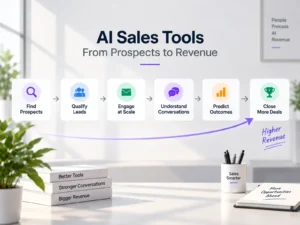
What Are AI Sales Tools?
AI sales tools are software applications that use Artificial Intelligence, machine learning, automation, natural language processing, and data analysis to help sales teams perform their work more efficiently.
These tools can assist with different stages of the sales process, including:
- Lead generation
- Lead qualification
- Customer research
- Email outreach
- Sales conversations
- Follow-up automation
- Customer relationship management
- Sales forecasting
- Data analysis
- Meeting summaries
- Proposal creation
- Customer personalization
For example, instead of manually researching hundreds of potential customers, an AI-powered sales platform can help identify prospects that match specific criteria.
Similarly, AI can analyze previous customer interactions and help sales representatives understand what type of message may be more relevant to a particular prospect.
The main purpose of AI sales tools is not simply automation. Their larger purpose is to help sales teams save time, work with better information, and create more personalized customer experiences.
Why Are AI Sales Tools Becoming Important?
The modern sales environment is highly competitive. Customers have access to more information than ever before, and they often research products and services before speaking with a salesperson.
This means businesses need to understand customer needs and communicate with prospects at the right time.
AI sales tools can help businesses handle large amounts of customer and sales data more efficiently.
Some major reasons businesses are adopting AI sales tools include:
1. Saving Time
Salespeople spend a significant amount of time on repetitive administrative activities.
AI can help automate tasks such as:
- Data entry
- Email drafting
- Lead research
- Meeting summaries
- Follow-up reminders
- CRM updates
- Report preparation
This gives sales professionals more time to communicate with potential customers.
2. Finding Better Leads
Not every lead has the same value.
AI can analyze available customer information and help sales teams identify prospects that are more relevant to their target audience.
This can help businesses focus their sales efforts instead of contacting random prospects.
3. Personalized Communication
Customers expect relevant communication.
AI can help sales teams create personalized emails, messages, offers, and follow-ups based on available customer information.
For example, instead of sending the same message to every prospect, a salesperson can use AI to create different messages based on the prospect’s industry, business size, interests, or previous interactions.
4. Faster Decision-Making
Sales teams generate large amounts of data.
AI can analyze this information and identify patterns that may be difficult to detect manually.
This can help managers understand sales performance, customer behavior, lead quality, and potential opportunities.
How Do AI Sales Tools Work?
AI sales tools generally work by collecting and analyzing information from different sources.
Depending on the platform, information may come from:
- CRM systems
- Websites
- Email conversations
- Sales calls
- Customer forms
- Marketing campaigns
- Social media
- Previous customer interactions
- Sales pipelines
AI algorithms process this information and generate useful insights or automate specific tasks.
For example, an AI system might analyze a sales pipeline and identify leads that have recently interacted with a company’s website or emails.
A sales representative can then prioritize those prospects for follow-up.
Modern AI sales tools may use technologies such as machine learning, natural language processing, predictive analytics, generative AI, and automation.
Best Uses of AI Sales Tools
AI can support almost every stage of the sales funnel.
Let’s look at some of the most useful applications.
1. AI for Lead Generation
Lead generation is one of the biggest challenges for many businesses.
Sales teams need a consistent flow of potential customers to maintain their sales pipeline.
AI sales tools can help businesses identify prospects based on specific characteristics.
For example, a B2B company may want to find:
- Marketing managers
- Business owners
- Startup founders
- E-commerce companies
- Technology companies
- Local businesses
AI-powered platforms can assist with prospect research and help sales teams organize potential customers.
However, businesses should always verify important prospect information before using it.
2. AI Lead Qualification
Generating leads is only the first step.
The next challenge is determining which leads are worth pursuing.
AI can analyze information such as:
- Customer profile
- Website activity
- Previous communication
- Product interest
- Engagement
- Company characteristics
- Purchase behavior
Based on available data, AI can help sales teams prioritize leads.
For example:
Lead A: Downloaded a guide six months ago and has not interacted again.
Lead B: Visited the pricing page multiple times and recently requested information.
A sales team may want to prioritize Lead B because the available signals indicate stronger current interest.
AI can help identify these patterns more quickly.
3. AI Email Sales Tools
Email remains an important sales channel.
However, writing personalized emails for every prospect can take significant time.
AI can assist with:
- Sales email writing
- Subject line ideas
- Follow-up messages
- Personalization
- Email summaries
- Response suggestions
- Outreach sequences
For example, a salesperson can provide basic information about a prospect and ask an AI tool to create a professional outreach email.
The salesperson should then review and customize the message before sending it.
Human editing remains important because AI-generated messages can sometimes sound generic or include inaccurate assumptions.
4. AI Follow-Up Automation
Following up is one of the most important parts of sales.
A potential customer may not respond to the first message. A second or third follow-up may be necessary.
AI-powered sales automation can help businesses create structured follow-up sequences.
For example:
Day 1: Initial introduction
Day 3: Helpful resource or additional information
Day 7: Follow-up message
Day 14: Final check-in
Automation can reduce the chance of forgetting important follow-ups.
At the same time, businesses should avoid excessive messaging. Customers should always have an easy way to stop receiving unwanted communication.
5. AI Sales Chatbots
AI-powered chatbots can interact with website visitors and answer common questions.
A sales chatbot can help visitors with:
- Product information
- Pricing questions
- Service details
- Availability
- Frequently asked questions
- Appointment booking
- Lead collection
For example, a digital marketing agency can use a chatbot to ask visitors about their business, website, marketing goals, and preferred services.
The chatbot can then collect the information and pass qualified leads to the sales team.
This can make the sales process faster, especially outside normal business hours.
6. AI for Sales Calls
Sales calls generate valuable information.
However, manually taking notes during every conversation can be difficult.
AI meeting and conversation tools can help by:
- Transcribing calls
- Creating summaries
- Identifying key discussion points
- Highlighting action items
- Organizing meeting notes
- Helping salespeople review conversations
For example, after a 45-minute sales meeting, an AI tool may create a short summary containing the customer’s main requirements, objections, and next steps.
This can save time and make follow-ups more organized.
7. AI for Sales Forecasting
Sales forecasting helps businesses estimate future sales performance.
Traditional forecasting often relies heavily on historical data and manual calculations.
AI-powered forecasting systems can analyze:
- Previous sales
- Pipeline activity
- Conversion rates
- Deal stages
- Customer behavior
- Sales trends
The resulting analysis can help managers understand potential changes in their sales pipeline.
However, AI forecasts should be treated as decision-support information rather than guaranteed predictions.
Market conditions can change quickly.
8. AI for Customer Relationship Management
Customer Relationship Management, commonly known as CRM, is an important part of sales operations.
AI can make CRM systems more useful by helping sales teams organize and understand customer information.
AI-powered CRM features may include:
- Automatic data entry
- Lead scoring
- Customer insights
- Follow-up suggestions
- Sales predictions
- Automated summaries
- Recommended actions
Instead of simply storing customer information, an AI-enhanced CRM can help sales teams interpret that information.
Popular AI Sales Tools
There are many AI-powered platforms available for sales and customer management. The right tool depends on the company’s size, industry, budget, workflow, and sales process.
Some widely known categories and platforms include:
HubSpot
HubSpot provides CRM, marketing, sales, customer service, and automation capabilities. Its AI features can assist with content creation, customer data, sales productivity, and business workflows.
Salesforce
Salesforce provides CRM and sales technology with AI-powered capabilities designed to assist businesses with customer information, automation, analytics, and sales workflows.
Microsoft Dynamics 365
Microsoft Dynamics 365 combines CRM and business applications. Its AI capabilities can support sales productivity, customer insights, and business processes.
Zoho CRM
Zoho CRM provides customer relationship management and sales automation features. AI capabilities can help users analyze customer information and improve sales workflows.
Gong
Gong focuses on revenue intelligence and conversation analysis. It can help sales teams analyze customer interactions and identify patterns in sales conversations.
Apollo
Apollo provides sales intelligence and prospecting features. It can help businesses research prospects and manage outreach activities.
ChatGPT
Generative AI tools such as ChatGPT can assist sales professionals with:
- Email writing
- Sales scripts
- Objection-handling ideas
- Customer research frameworks
- Proposal drafts
- Meeting preparation
- Follow-up messages
- Sales content
The exact capabilities available can vary depending on the product and plan.
AI Sales Tools for Small Businesses
Small businesses often have limited budgets and smaller teams.
AI can be particularly useful because a small sales team may need to handle multiple responsibilities.
For example, one person might be responsible for:
- Finding leads
- Sending emails
- Managing social media
- Answering customer questions
- Preparing proposals
- Following up
- Updating CRM records
AI tools can help automate some of these tasks.
A small digital marketing agency could use AI to create lead lists, draft outreach emails, summarize meetings, prepare proposals, and organize follow-ups.
This does not eliminate the need for human sales skills. Instead, it can allow the salesperson to spend more time talking to prospects and understanding their requirements.
AI Sales Tools for Digital Marketing Agencies
Digital marketing agencies can use AI sales tools to improve their lead-generation and client-acquisition process.
For example, an agency can build a workflow like:
Lead Generation → Lead Qualification → Personalized Outreach → Meeting → Proposal → Follow-Up → Conversion
AI can support each stage.
A marketing agency offering SEO, website development, Google Ads, Meta Ads, and social media marketing could use AI to create customized outreach messages for different industries.
For example:
For a restaurant: Focus on local SEO, Google Business Profile, reviews, and social media.
For an e-commerce business: Focus on SEO, paid advertising, conversion optimization, and remarketing.
For a local service provider: Focus on Google Business Profile, local SEO, website optimization, and lead generation.
This type of personalization can make sales communication more relevant.
Benefits of AI Sales Tools
AI sales tools can provide several potential benefits.
Increased Productivity
Automation can reduce the time spent on repetitive tasks.
Better Lead Management
AI can help sales teams organize and prioritize prospects.
Personalized Communication
AI can help create customized messages for different customer groups.
Faster Research
Salespeople can use AI to summarize information and prepare for customer conversations.
Improved Customer Experience
Faster responses and relevant communication can improve the customer journey.
Data-Driven Decisions
AI can help businesses identify patterns in customer and sales data.
Scalable Sales Processes
Automation can make it easier to handle larger numbers of leads without increasing administrative work at the same rate.
Limitations of AI Sales Tools
Although AI sales tools offer many advantages, they also have limitations.
1. AI Can Make Mistakes
AI-generated information can be incorrect or incomplete.
Important customer information should always be verified.
2. Generic Communication
If AI-generated emails are used without editing, they may sound repetitive or impersonal.
3. Data Privacy
Businesses need to understand how customer information is collected, stored, processed, and shared by the tools they use.
4. Human Relationships Still Matter
Sales is fundamentally about understanding people.
AI can assist with research and automation, but trust, empathy, negotiation, and relationship-building still require human involvement.
5. Cost
Some advanced AI sales platforms can become expensive as a business grows.
Companies should calculate whether the tool provides enough value before investing in it.
How to Choose Ai sales Tools
Before purchasing an AI sales platform, businesses should evaluate their actual requirements.
Consider these questions:
What problem are you trying to solve?
Do you need more leads?
Do you need better follow-ups?
Do you want to automate email outreach?
Do you need CRM automation?
Do you need sales-call analysis?
Identify the problem first.
Does It Integrate With Your Existing Tools?
Check whether the platform works with your CRM, email system, website, calendar, advertising platforms, and other business software.
Is It Easy to Use?
A powerful tool is not useful if your team cannot use it effectively.
What Is the Pricing Structure?
Compare the total cost, including user limits, automation limits, additional features, and upgrades.
What About Data Security?
Review the provider’s privacy and security documentation before connecting sensitive customer information.
Best Practices for Using AI Sales Tools
To get better results from AI sales tools, businesses should follow some basic principles.
Use AI as an Assistant
Think of AI as a sales assistant rather than a complete replacement for your sales team.
Review AI-Generated Content
Always check important emails, proposals, customer information, and claims before sending them.
Keep Customer Data Organized
Good data leads to better insights. Poor-quality or outdated information can reduce the usefulness of AI systems.
Personalize Your Communication
Do not send the exact same AI-generated message to every prospect.
Add relevant details and focus on the customer’s actual needs.
Track Results
Monitor metrics such as:
- Response rate
- Qualified leads
- Meeting bookings
- Conversion rate
- Sales cycle length
- Revenue
- Customer retention
Use these metrics to understand whether your AI workflow is actually helping.
AI Sales Tools and the Future of Sales
The future of sales is likely to involve closer cooperation between humans and AI.
AI will continue to become more capable of analyzing information, automating workflows, generating content, and supporting customer interactions.
Sales professionals may increasingly use AI assistants that can help them prepare for meetings, identify important leads, summarize conversations, and recommend next steps.
However, human skills will remain important.
Customers still value trust, communication, expertise, transparency, and personal attention.
The strongest sales processes are likely to combine AI efficiency with human relationship-building.
AI Sales Tools vs Traditional Sales
Traditional sales processes often depend heavily on manual research, spreadsheets, repetitive emails, and individual follow-ups.
AI-supported sales processes can automate many of these repetitive activities.
For example:
| Traditional Sales | AI-Supported Sales |
|---|---|
| Manual lead research | AI-assisted prospect research |
| Manual data entry | Automated CRM updates |
| Generic emails | Personalized AI-assisted emails |
| Manual meeting notes | AI-generated summaries |
| Manual follow-up reminders | Automated workflows |
| Basic reporting | AI-assisted data analysis |
| Manual customer segmentation | Data-driven segmentation |
The goal is not necessarily to remove humans from sales.
Instead, AI can reduce repetitive work so sales professionals can spend more time on higher-value activities.
Common Mistakes When Using AI Sales Tools
Businesses can make mistakes when implementing AI.
Using AI Without a Strategy
Buying an AI tool without understanding the problem it should solve can waste money.
Automating Everything
Not every customer interaction should be automated.
Important conversations often require a human.
Ignoring Data Quality
AI systems depend heavily on the information available to them.
Incorrect or outdated information can lead to poor results.
Sending Too Many Automated Messages
Automation should improve communication, not turn it into spam.
Not Measuring Results
Businesses should track performance before and after implementing AI.
A Simple AI Sales Workflow
A business can start with a simple workflow:
Step 1: Identify Your Target Customer
Define your ideal customer based on industry, location, company size, needs, and other relevant characteristics.
Step 2: Generate Prospects
Use appropriate sales intelligence or research tools to identify potential customers.
Step 3: Qualify Leads
Evaluate whether each prospect fits your target customer profile.
Step 4: Create Personalized Outreach
Use AI to draft personalized emails or messages.
Step 5: Schedule Follow-Ups
Create appropriate follow-up sequences.
Step 6: Conduct the Sales Meeting
Use AI to prepare questions and organize meeting notes, while keeping the actual conversation human.
Step 7: Prepare the Proposal
AI can help structure proposals based on the customer’s requirements.
Step 8: Analyze Results
Track conversion rates and identify where prospects are dropping out of the sales funnel.
Conclusion
AI sales tools are transforming modern sales by helping businesses automate repetitive tasks, improve lead management, personalize communication, analyze customer data, and increase sales productivity.
From AI-powered CRM systems and sales chatbots to email assistants, lead-generation platforms, conversation intelligence, and generative AI, businesses now have many options for improving their sales processes.
However, successful AI adoption requires more than simply purchasing a tool. Businesses need a clear sales strategy, accurate data, appropriate automation, human oversight, and continuous measurement.
AI should be used to support sales professionals, not blindly replace human interaction. The combination of Artificial Intelligence and human expertise can help businesses create more organized, responsive, and scalable sales processes.
For digital marketers, agencies, startups, and small businesses, learning how to use AI sales tools effectively can become an important part of building a modern customer-acquisition strategy.
The future of sales is not simply about using more technology. It is about using technology intelligently while keeping customer needs and human relationships at the center of the sales process.