
Artificial Intelligence has become one of the most important technologies of the modern digital world. From search engines and recommendation systems to chatbots, self-driving technologies, image generators, business automation, and digital assistants, AI is increasingly becoming part of everyday life.
However, for someone who is just starting to learn about artificial intelligence, the terminology can be confusing.
You may have heard terms such as Artificial Intelligence (AI), Machine Learning (ML), Deep Learning, Generative AI, Large Language Models (LLMs), Natural Language Processing (NLP), neural networks, prompts, tokens, AI models, training data, and automation.
What do all these terms mean?
Are AI and Machine Learning the same thing?
Is ChatGPT an AI or an LLM?
What exactly is Generative AI?
How does an AI model learn?
What is a prompt?
What are tokens?
This complete beginner’s guide explains these concepts in simple language.
By the end of this article, you should have a much clearer understanding of the AI ecosystem and the terminology used in modern artificial intelligence.
Table of Contents
- What Is Artificial Intelligence?
- How Does AI Work?
- Examples of AI in Everyday Life
- Types of Artificial Intelligence
- What Is Machine Learning?
- How Machine Learning Works
- Types of Machine Learning
- What Is Deep Learning?
- What Are Neural Networks?
- AI vs Machine Learning vs Deep Learning
- What Is Generative AI?
- How Generative AI Works
- Examples of Generative AI
- What Are Large Language Models?
- How LLMs Work
- Chatbots vs LLMs
- What Is Natural Language Processing?
- What Is Computer Vision?
- What Is an AI Model?
- What Is Training Data?
- What Is a Dataset?
- What Is an Algorithm?
- What Is a Prompt?
- What Is Prompt Engineering?
- What Are Tokens?
- What Are Parameters?
- What Is an AI Inference?
- What Is Fine-Tuning?
- What Is RAG?
- What Are AI Hallucinations?
- What Is an AI Agent?
- What Is AI Automation?
- What Is an AI API?
- What Is an AI Assistant?
- What Is Multimodal AI?
- What Is Speech Recognition?
- What Is Text-to-Speech?
- What Is Image Generation?
- What Is AI Video Generation?
- What Is Reinforcement Learning?
- What Is Reinforcement Learning From Human Feedback?
- What Is Supervised Learning?
- What Is Unsupervised Learning?
- What Is Classification?
- What Is Regression?
- What Is Clustering?
- What Is Computer-Generated Content?
- AI Bias
- AI Safety
- AI Ethics
- AI Privacy
- AI Security
- Responsible AI
- AI vs Automation
- AI vs Traditional Software
- Benefits of AI
- Limitations of AI
- Common AI Myths
- AI in Digital Marketing
- AI in Business
- AI in Education
- AI in Healthcare
- AI in Finance
- AI in Customer Service
- AI in Content Creation
- AI in SEO
- AI Skills for Beginners
- How Beginners Can Start Learning AI
- AI Terminology Cheat Sheet
- Conclusion
1. What Is Artificial Intelligence?
Artificial Intelligence, commonly called AI, is a field of computer science focused on creating computer systems that can perform tasks that normally require some form of human intelligence.
These tasks can include:
- Understanding language
- Recognizing images
- Identifying patterns
- Making predictions
- Solving problems
- Generating content
- Making recommendations
- Understanding speech
- Supporting decision-making
- Interacting with users
In simple terms:
AI is technology that enables computers to perform tasks that appear intelligent.
For example, when a navigation application recommends the fastest route, an AI-powered recommendation system suggests a movie, or a chatbot answers a question, artificial intelligence may be involved.
AI does not necessarily mean that a computer thinks exactly like a human.
Instead, AI systems are designed to perform particular tasks using algorithms, data, models, and computational resources.
2. How Does AI Work?
At a basic level, an AI system works by using:
Data + Algorithms + Computing Power + Models = AI System
Data provides information.
Algorithms provide methods for processing that information.
Computing power allows systems to perform large numbers of calculations.
Models represent patterns learned from data.
Consider an AI system designed to recognize cats in photographs.
The system may be trained using thousands or millions of images containing cats and other objects.
During training, the model learns statistical patterns associated with cats.
Later, when a new photograph is provided, the system analyzes the image and generates a prediction.
The important point is that the AI system generally does not memorize one simple definition of a cat.
Instead, it learns patterns from examples.
3. Examples of AI in Everyday Life
You may already use AI every day without realizing it.
Search Engines
Search engines use sophisticated algorithms and machine-learning systems to understand queries and return relevant information.
Recommendation Systems
Streaming services, shopping websites, and social platforms can recommend content based on patterns in user behavior.
Smartphones
Modern smartphones use AI for features such as:
- Face recognition
- Voice assistants
- Camera enhancement
- Spam detection
- Predictive text
Email platforms can use AI to identify spam, categorize messages, and assist with writing.
Maps
Navigation systems can analyze traffic and other information to estimate travel times and recommend routes.
Customer Service
Businesses increasingly use AI-powered chatbots to answer frequently asked questions.
Content Creation
Generative AI systems can help users create:
- Articles
- Images
- Videos
- Audio
- Presentations
- Code
AI is therefore not limited to robots or science-fiction applications.
It is already integrated into many ordinary digital experiences.
4. Types of Artificial Intelligence
AI can be categorized in several different ways.
One common conceptual classification is:
Artificial Narrow Intelligence
Artificial Narrow Intelligence, often called narrow AI, refers to systems designed to perform specific tasks.
Examples include:
- Spam filters
- Recommendation systems
- Image classifiers
- Translation systems
- Voice recognition systems
Most AI systems used today fall into this broad category.
Artificial General Intelligence
Artificial General Intelligence, or AGI, generally refers to a hypothetical form of AI capable of performing a broad range of intellectual tasks at a level comparable to humans or beyond.
AGI remains a major topic of research and debate.
Artificial Superintelligence
Artificial Superintelligence is a hypothetical concept describing an AI system whose general intellectual capabilities substantially exceed those of humans.
It is largely discussed as a future or theoretical possibility rather than an established technology.
5. What Is Machine Learning?
Machine Learning, commonly abbreviated as ML, is a subfield of artificial intelligence.
Instead of explicitly programming every rule for a task, machine-learning systems learn patterns from data.
A simple way to understand it is:
AI is the broader field. Machine Learning is one way of building AI systems.
Imagine that you want a computer to distinguish between spam and legitimate emails.
A traditional approach might require programmers to manually create many rules.
A machine-learning approach can provide the system with examples of spam and legitimate messages.
The model analyzes these examples and learns patterns associated with each category.
When a new email arrives, the trained model can make a prediction.
6. How Machine Learning Works
A simplified machine-learning process looks like this:
Step 1: Collect Data
The first step is obtaining relevant data.
For example:
- Customer records
- Images
- Text
- Audio
- Sales data
- Website activity
Step 2: Prepare the Data
Raw data often contains errors, duplicates, missing values, or irrelevant information.
Data may need to be cleaned and organized.
Step 3: Select a Model
A suitable machine-learning approach is selected depending on the problem.
Step 4: Train the Model
The model analyzes the training data and adjusts its internal parameters to identify useful patterns.
Step 5: Evaluate the Model
The system is tested using data that it did not use during training.
Step 6: Deploy the Model
If performance is acceptable, the model can be used in a real application.
Step 7: Monitor Performance
Real-world data can change over time, so AI systems may need monitoring and updating.
7. Types of Machine Learning
Machine learning is commonly divided into several categories.
Supervised Learning
In supervised learning, the model learns from labeled examples.
For example:
Input: Photograph
Label: Dog
The model learns relationships between inputs and labels.
Common supervised-learning tasks include:
- Classification
- Regression
- Prediction
Unsupervised Learning
In unsupervised learning, the data does not have predefined labels.
The system attempts to identify patterns or structures within the data.
For example, a business might use clustering to identify groups of customers with similar behavior.
Reinforcement Learning
Reinforcement learning involves an agent interacting with an environment and receiving feedback based on its actions.
The system learns strategies that can maximize a reward over time.
8. What Is Deep Learning?
Deep Learning is a specialized area of machine learning that uses multi-layered neural networks.
The term “deep” refers to the multiple layers used within these networks.
Deep-learning techniques have played a major role in advances involving:
- Image recognition
- Speech recognition
- Natural language processing
- Generative AI
- Computer vision
Large amounts of data and significant computing resources can be used to train deep-learning models.
9. What Are Neural Networks?
Neural networks are computational models inspired loosely by the structure of biological nervous systems.
A neural network can contain layers of interconnected computational units.
A simplified neural network has:
Input Layer → Hidden Layers → Output Layer
For example, an image classification model might receive pixels as input.
The network processes information through multiple layers and produces an output such as:
“Cat: 92%”
These percentages are examples of model confidence scores and should not automatically be interpreted as absolute certainty.
10. AI vs Machine Learning vs Deep Learning
These terms are related but not identical.
Artificial Intelligence
The broad field concerned with creating systems capable of performing tasks associated with intelligence.
Machine Learning
A subset of AI where systems learn patterns from data.
Deep Learning
A subset of machine learning that uses multi-layer neural networks.
The relationship can be visualized as:
Artificial Intelligence
↓
Machine Learning
↓
Deep Learning
This distinction is one of the most important concepts for AI beginners.
11. What Is Generative AI?
Generative AI refers to AI systems that can generate new content based on patterns learned from data.
Unlike systems designed primarily to classify or predict existing categories, generative AI can produce outputs such as:
- Text
- Images
- Audio
- Video
- Code
- Music
- Designs
For example, a user can provide a text prompt asking an AI system to write an article introduction.
The system generates new text based on its learned patterns.
This is why the term Generative AI has become so widely used.
12. How Does Generative AI Work?
Generative AI models are trained on large collections of data.
During training, models learn statistical relationships and patterns.
For a language model, this can involve learning relationships among words and other language units.
For image-generation systems, the model learns patterns associated with visual data.
When a user provides an input, the model processes it and generates an output based on its learned representations and the instructions provided.
A simplified process is:
User Input → AI Model → Pattern Processing → Generated Output
The actual technology behind modern generative models is considerably more complex.
13. Examples of Generative AI
Generative AI can be used for many different tasks.
Text Generation
AI can generate:
- Blog drafts
- Emails
- Product descriptions
- Summaries
- Ideas
- Scripts
Image Generation
AI systems can generate images from text descriptions.
Code Generation
AI can assist programmers by generating or explaining code.
Audio Generation
Some systems can generate or transform speech and other forms of audio.
Video Generation
Generative models can increasingly create or modify video content.
Generative AI therefore represents a broad category rather than a single tool.
14. What Are Large Language Models?
A Large Language Model, or LLM, is an AI model designed to process and generate human language.
LLMs are trained on large amounts of text and use neural-network architectures to learn patterns in language.
They can perform tasks such as:
- Answering questions
- Summarizing text
- Translating languages
- Generating content
- Extracting information
- Brainstorming
- Assisting with programming
- Conversational interaction
Modern LLMs are an important part of the generative-AI ecosystem.
15. How Do LLMs Work?
At a simplified level, an LLM processes text as sequences of tokens.
During training, it learns statistical relationships between these tokens.
When generating an answer, the model predicts what token or sequence of tokens should come next based on the context.
For example, consider:
“The sun rises in the…”
A language model may predict that “east” is a likely continuation.
Modern LLMs can perform far more complicated language tasks because their training and architectures allow them to model relationships across large contexts.
However, an LLM does not automatically “know” something in exactly the same way a human does.
Its outputs are generated through computational processes learned from data.
16. Chatbots vs LLMs
A chatbot and an LLM are not necessarily the same thing.
An LLM is the underlying language model.
A chatbot is an application or interface that allows users to interact conversationally with an AI system.
A chatbot may use:
- An LLM
- A user interface
- Conversation history
- Retrieval systems
- External tools
- Safety mechanisms
- Databases
- APIs
Therefore:
LLM = model
Chatbot = application that may use a model
This distinction becomes important when learning about AI products.
17. What Is Natural Language Processing?
Natural Language Processing, or NLP, is a field of AI concerned with enabling computers to process and work with human language.
NLP applications include:
- Translation
- Sentiment analysis
- Text classification
- Speech-related applications
- Search
- Summarization
- Question answering
Large language models represent a major development within modern language-processing technology.
18. What Is Computer Vision?
Computer Vision is a field of AI focused on enabling computers to process and interpret visual information.
Computer-vision applications include:
- Object detection
- Image classification
- Facial recognition
- Medical-image analysis
- OCR
- Quality inspection
- Autonomous systems
For example, an AI system might analyze an image and identify objects such as cars, people, roads, or signs.
19. What Is an AI Model?
An AI model is a computational system that has learned patterns from data or has been designed to perform a particular task.
A model can receive input and produce an output.
Examples:
Input → Model → Output
For a classification model:
Image → Model → “Dog”
For a language model:
Prompt → Model → Generated Text
For an image-generation system:
Text Prompt → Model → Image
The term “model” is therefore extremely common in AI discussions.
20. What Is Training Data?
Training data is the information used to train an AI model.
Depending on the system, training data can include:
- Text
- Images
- Audio
- Video
- Tables
- Code
- Sensor information
The quality, relevance, diversity, and preparation of training data can strongly affect the resulting system.
A common principle in machine learning is:
Better data can contribute to better model performance.
However, data quality is only one factor. Model architecture, training methods, evaluation, computing resources, and deployment conditions also matter.
21. What Is a Dataset?
A dataset is an organized collection of data used for analysis, machine learning, research, or other computational purposes.
For example, an image dataset might contain thousands of photographs.
A customer dataset might contain:
- Customer ID
- Age
- Purchase history
- Location
- Product category
Datasets can be structured or unstructured.
22. What Is an Algorithm?
An algorithm is a defined procedure or set of instructions used to solve a problem or perform a task.
Algorithms are not exclusive to AI.
They are used throughout computer science.
In AI and machine learning, algorithms can determine how systems:
- Learn patterns
- Optimize parameters
- Process information
- Make predictions
A machine-learning model is often trained using algorithms that adjust model parameters to reduce errors or improve an objective.
23. What Is a Prompt?
A prompt is an instruction, question, or input provided to an AI system.
For example:
“Write a 500-word blog introduction about digital marketing.”
That sentence is a prompt.
A prompt can contain:
- Instructions
- Context
- Examples
- Constraints
- Desired format
- Background information
Better prompts often provide clearer instructions and context.
24. What Is Prompt Engineering?
Prompt engineering refers to the practice of designing and refining prompts to obtain useful results from AI systems.
For example, instead of saying:
“Write about SEO.”
A more detailed prompt might say:
“Write a beginner-friendly 1,000-word article explaining SEO. Use simple language, include five practical examples, and organize the article using H2 and H3 headings.”
The second prompt gives the AI more information about the desired output.
Prompt engineering can be useful for:
- Content creation
- Research
- Coding
- Marketing
- Data analysis
- Education
- Business workflows
25. What Are Tokens?
Tokens are units of text that language models process.
A token may represent:
- A word
- Part of a word
- Punctuation
- Other text fragments
The exact tokenization depends on the model and tokenizer.
For example, a sentence is converted into tokens before being processed by a language model.
Tokens are important because AI systems often have limits related to:
- Input length
- Output length
- Context window
- Processing cost
26. What Are Parameters?
Parameters are internal values learned by an AI model during training.
They help determine how the model transforms inputs into outputs.
Large neural networks can contain enormous numbers of parameters.
However, parameter count alone does not tell you everything about a model’s quality.
Other factors include:
- Architecture
- Training data
- Training methods
- Fine-tuning
- Evaluation
- Inference methods
- Tool use
27. What Is AI Inference?
Inference is the process of using a trained AI model to generate a prediction or output.
Training and inference are different.
Training
The model learns from data.
Inference
The trained model processes new input.
For example:
Training:
Thousands of examples → Model learns patterns
Inference:
New input → Model produces output
When you send a prompt to an AI application and receive an answer, the model is performing inference.
28. What Is Fine-Tuning?
Fine-tuning involves taking a pretrained model and further training it on a more specific dataset or task.
For example, a general language model might be adapted for a specialized use case.
Fine-tuning can help a model become more suitable for:
- Specific domains
- Specific tasks
- Particular response styles
- Specialized terminology
Fine-tuning is different from simply writing better prompts.
29. What Is RAG?
RAG stands for Retrieval-Augmented Generation.
RAG combines information retrieval with generative AI.
Instead of relying only on information stored in a model’s learned parameters, a RAG system can retrieve relevant information from an external knowledge source and provide that information to the generation system.
A simplified workflow is:
User Question
↓
Search/Retrieve Relevant Information
↓
AI Model
↓
Generated Answer
RAG can be useful for applications involving:
- Company documents
- Knowledge bases
- Product information
- Internal policies
- Research collections
It can help ground answers in specific information sources, although retrieval quality and system design remain important.
30. What Are AI Hallucinations?
An AI hallucination occurs when an AI system generates information that appears plausible but is incorrect, unsupported, or fabricated.
For example, an AI system might:
- Invent a citation
- Give an incorrect date
- Attribute a quote to the wrong person
- Create a nonexistent source
- State an incorrect fact confidently
This is one of the most important limitations beginners should understand.
AI-generated information should not automatically be assumed to be correct.
For important information, users should verify claims using reliable sources.
31. What Is an AI Agent?
An AI agent generally refers to a system that can use AI models to perform tasks, sometimes by planning actions, using tools, interacting with external systems, and responding to changing conditions.
A simple chatbot might only answer questions.
An agentic system may be able to:
- Understand a goal
- Break the goal into tasks
- Select tools
- Perform actions
- Observe results
- Continue working
- Produce a final result
The exact definition of “AI agent” varies across products and research communities.
32. What Is AI Automation?
AI automation involves using AI technologies to automate tasks or workflows that previously required more manual effort.
Examples include:
- Automatically summarizing customer messages
- Classifying leads
- Drafting emails
- Extracting information from documents
- Generating reports
- Categorizing support tickets
AI automation can combine AI models with traditional software automation.
33. What Is an AI API?
An API, or Application Programming Interface, allows software applications to communicate with another service.
An AI API allows developers to integrate AI capabilities into their own applications.
For example:
Your Website → API → AI Model → Response → Your Website
Developers can use APIs for applications such as:
- Chatbots
- Content tools
- Search systems
- Document processing
- AI assistants
34. What Is an AI Assistant?
An AI assistant is an application designed to help users complete tasks using artificial intelligence.
Depending on the system, an assistant may:
- Answer questions
- Draft content
- Summarize information
- Organize tasks
- Analyze data
- Generate ideas
- Assist with coding
AI assistants can range from simple chat interfaces to sophisticated systems connected to external tools.
35. What Is Multimodal AI?
Multimodal AI can work with more than one type of information or modality.
Modalities can include:
- Text
- Images
- Audio
- Video
- Structured data
For example, a multimodal AI system might receive an image and a written question and produce a text response.
This is different from a system designed exclusively for text.
36. What Is Speech Recognition?
Speech recognition is technology that converts spoken language into machine-readable text or otherwise interprets speech.
Applications include:
- Voice assistants
- Automatic transcription
- Meeting transcription
- Voice commands
- Accessibility tools
Speech recognition is closely connected to AI and machine learning.
37. What Is Text-to-Speech?
Text-to-Speech, often abbreviated as TTS, converts written text into synthesized speech.
Modern AI-based systems can produce increasingly natural-sounding voices.
Applications include:
- Accessibility
- Voice assistants
- Audiobooks
- Video production
- Education
- Customer-service systems
38. What Is AI Image Generation?
AI image generation uses generative models to create images based on user instructions or other inputs.
For example, a user might provide:
“Create a modern digital marketing office with computers, charts, and a professional team.”
An image-generation system can create a visual representation based on the prompt.
Image generation is commonly used for:
- Marketing
- Advertising
- Social media
- Concept design
- Illustrations
- Creative experimentation
39. What Is AI Video Generation?
AI video generation refers to systems capable of generating or modifying video using AI.
Depending on the tool, users may provide:
- Text prompts
- Images
- Existing video
- Storyboards
- Instructions
Potential applications include:
- Advertising
- Social media
- Education
- Film previsualization
- Product demonstrations
As with other generative systems, output quality varies by model and use case.
40. What Is Reinforcement Learning?
Reinforcement Learning, or RL, is a machine-learning approach where an agent learns by interacting with an environment.
The agent performs actions.
The environment provides feedback.
The feedback can include rewards or penalties.
Over time, the agent learns strategies that can improve its expected reward.
A simple example is a game-playing system.
The system tries different actions and learns which strategies lead to better outcomes.
41. What Is Reinforcement Learning From Human Feedback?
Reinforcement Learning From Human Feedback, often abbreviated RLHF, is a technique used to incorporate human preferences into the training or alignment of AI models.
Humans may evaluate or rank different outputs.
That feedback can be used to train systems to produce responses that better match desired characteristics.
RLHF has become particularly associated with the development of conversational AI systems.
42. What Is Supervised Learning?
Supervised learning uses labeled training examples.
For example:
| Input | Label |
|---|---|
| Email A | Spam |
| Email B | Not Spam |
| Email C | Spam |
The model learns from these examples.
After training, it can classify new emails.
Supervised learning is widely used in:
- Classification
- Prediction
- Image recognition
- Fraud detection
- Forecasting
43. What Is Unsupervised Learning?
Unsupervised learning works with data that does not have predefined labels.
The goal may be to identify hidden structures or patterns.
For example, an e-commerce company could use clustering to discover groups of customers with similar purchasing behavior.
The model may identify groups without being told in advance what those groups should be.
44. What Is Classification?
Classification is a machine-learning task where a system assigns an input to one or more categories.
Examples:
Email → Spam
Image → Dog
Review → Positive
Transaction → Potential Fraud
Classification is widely used in real-world machine-learning systems.
45. What Is Regression?
Regression is a machine-learning approach used to predict numerical values.
For example:
- House price prediction
- Sales forecasting
- Demand estimation
- Temperature prediction
If a system predicts that a property may cost ₹50 lakh, the output is a numerical estimate rather than a category.
46. What Is Clustering?
Clustering is a technique used to group similar data points together.
For example, an online store might discover groups such as:
- Frequent buyers
- Occasional buyers
- Discount-focused customers
- High-value customers
The groups are discovered based on patterns in the data.
47. What Is AI-Generated Content?
AI-generated content is content created partly or entirely with the help of AI systems.
It can include:
- Articles
- Images
- Videos
- Music
- Audio
- Presentations
- Code
AI-generated content can increase productivity, but users should still review content for:
- Accuracy
- Originality
- Relevance
- Quality
- Copyright considerations
- Brand consistency
48. What Is AI Bias?
AI bias occurs when an AI system produces systematically skewed or unfair outcomes.
Bias can arise from multiple sources, including:
- Training data
- Data collection
- Labeling
- Model design
- Deployment conditions
- Human decisions
For example, if training data does not adequately represent certain populations, a system may perform differently across groups.
Understanding AI bias is important when AI is used for high-impact decisions.
49. What Is AI Safety?
AI safety broadly refers to efforts to reduce harmful or unintended behavior from AI systems.
Safety can involve:
- Testing
- Monitoring
- Access controls
- Human oversight
- Robustness evaluation
- Security
- Content safeguards
AI safety is especially important as AI systems become more capable and are integrated into important workflows.
50. What Is AI Ethics?
AI ethics involves questions about the responsible development and use of artificial intelligence.
Topics can include:
- Fairness
- Privacy
- Transparency
- Accountability
- Bias
- Human oversight
- Copyright
- Safety
AI technology can create benefits, but responsible implementation is necessary to reduce potential harms.
51. What Is AI Privacy?
AI privacy concerns how personal and sensitive information is collected, processed, stored, and used by AI systems.
Users should be careful when entering sensitive information into AI tools.
Organizations should consider:
- Data protection
- Access control
- Retention
- Compliance
- Security
- Data minimization
A useful beginner principle is:
Do not share sensitive information with an AI tool unless you understand how that information is handled.
52. What Is AI Security?
AI security focuses on protecting AI systems, their data, infrastructure, and users.
Potential concerns include:
- Data theft
- Prompt injection
- Model abuse
- Unauthorized access
- Data poisoning
- Adversarial attacks
AI security becomes increasingly important when models are connected to business systems and external tools.
53. What Is Responsible AI?
Responsible AI refers to developing and using AI in ways that consider safety, fairness, privacy, accountability, transparency, and human impact.
A responsible AI approach can include:
- Testing systems
- Monitoring performance
- Protecting personal data
- Reviewing outputs
- Maintaining human oversight
- Documenting limitations
Responsible AI is not only a technical issue.
It also involves organizational policies and human decision-making.
54. AI vs Automation
AI and automation are related but different.
Automation
Automation means using technology to perform tasks with limited human intervention.
For example:
“If a customer submits a form, automatically send a confirmation email.”
This can happen without AI.
AI Automation
AI can be added when a task requires interpretation or generation.
For example:
“When a customer sends a message, analyze the message, identify the topic, draft a response, and route it to the appropriate team.”
Traditional automation follows predefined rules.
AI can handle tasks involving patterns, language, prediction, or generation.
55. AI vs Traditional Software
Traditional software generally follows explicitly programmed instructions.
For example:
If condition A occurs → perform action B.
Machine-learning systems can instead learn patterns from data.
This does not mean traditional programming is disappearing.
Modern applications often combine:
- Traditional software
- Databases
- APIs
- Machine learning
- Generative AI
- Automation
AI is therefore usually part of a larger software ecosystem.
56. Benefits of AI
AI can provide several potential benefits.
Productivity
AI can help users complete repetitive or time-consuming tasks faster.
Content Creation
AI can assist with brainstorming, drafting, editing, and ideation.
Data Analysis
Machine-learning systems can identify patterns in large datasets.
Customer Support
AI can assist with frequently asked questions and customer interactions.
Personalization
AI can help businesses tailor experiences to users.
Accessibility
Speech recognition, text-to-speech, translation, and other technologies can improve accessibility.
Research Assistance
AI can help organize and summarize information, although important claims still require verification.
57. Limitations of AI
AI is powerful, but it is not perfect.
Important limitations include:
Incorrect Information
AI systems can produce inaccurate answers.
Hallucinations
Generative systems can create plausible but unsupported information.
Bias
Models can reflect or amplify problems in their training or deployment data.
Lack of Context
AI may misunderstand ambiguous instructions.
Privacy Risks
Sensitive information can create privacy concerns.
Dependence on Data
Many AI systems require large quantities of relevant data.
Cost
Developing and operating advanced AI systems can require substantial computing resources.
Understanding limitations is just as important as understanding capabilities.
58. Common AI Myths
Myth 1: AI Is the Same as a Human Brain
AI systems and biological brains operate in fundamentally different ways.
Myth 2: AI Always Gives Correct Answers
It does not.
AI-generated information should be checked when accuracy matters.
Myth 3: All AI Is Generative AI
Generative AI is one category within the broader AI field.
Myth 4: Machine Learning and AI Are Identical
Machine learning is a subset of AI.
Myth 5: AI Can Understand Everything Like a Human
AI systems can process information impressively, but their capabilities and limitations differ from human cognition.
Myth 6: Bigger Models Are Automatically Better
Model size alone does not determine overall usefulness or performance.
59. AI in Digital Marketing
Artificial intelligence is becoming increasingly important in digital marketing.
Marketers can use AI to assist with:
- Keyword research
- Content ideas
- Content drafting
- Audience analysis
- Ad copy
- Social media posts
- Email campaigns
- Customer segmentation
- Reporting
- Data analysis
For example, a marketer can use AI to brainstorm ten blog topics for a specific audience.
The marketer can then evaluate the ideas, conduct research, add expertise, and create the final content.
AI can therefore act as a productivity tool rather than simply replacing the entire marketing process.
60. AI in Business
Businesses can use AI across multiple departments.
Marketing
AI can support campaign planning and content production.
Sales
AI can help analyze leads and customer interactions.
Customer Service
AI can answer common questions and route support requests.
Operations
AI can assist with forecasting and process optimization.
Human Resources
AI can assist with administrative workflows, although high-impact decisions require appropriate safeguards and human oversight.
Finance
Machine-learning systems can support forecasting, anomaly detection, and other analytical tasks.
61. AI in Education
AI can support learning through:
- Personalized explanations
- Study assistance
- Language practice
- Summaries
- Quiz generation
- Tutoring systems
- Accessibility tools
However, students should use AI as a learning aid rather than blindly submitting generated answers.
Learning requires understanding, evaluation, and independent thinking.
62. AI in Healthcare
AI is being explored and deployed across many healthcare applications, including:
- Medical-image analysis
- Administrative workflows
- Clinical decision support
- Drug research
- Patient communication
Healthcare is a high-stakes area.
AI outputs should therefore be appropriately validated and should not automatically replace qualified medical professionals.
63. AI in Finance
Financial institutions can use AI and machine learning for applications such as:
- Fraud detection
- Risk analysis
- Customer service
- Forecasting
- Document processing
Because financial decisions can have significant consequences, organizations need appropriate governance and oversight.
64. AI in Customer Service
AI-powered customer-service systems can help organizations:
- Answer frequently asked questions
- Classify support tickets
- Summarize conversations
- Route requests
- Generate response drafts
Human support remains important for complex, sensitive, or unusual cases.
65. AI in Content Creation
AI has transformed the content-creation process.
Creators can use AI for:
- Topic research
- Brainstorming
- Outlines
- First drafts
- Editing
- Image concepts
- Video ideas
- Social media content
The best workflow is often not:
AI creates everything.
Instead:
Human expertise + AI assistance + Human review
This approach can combine efficiency with quality control.
66. AI in SEO
AI can support many SEO activities.
For example:
Keyword Research
AI can help brainstorm keyword themes.
Content Planning
AI can organize content clusters.
Search Intent
AI can help categorize queries according to likely intent.
Content Outlines
AI can help structure articles.
Content Optimization
AI can identify missing topics or questions.
Reporting
AI can help summarize analytics data.
However, SEO success depends on many factors beyond AI-generated text.
High-quality content should provide genuine value, accurate information, useful experience, and a good user experience.
67. AI Skills for Beginners
If you are new to AI, you do not need to learn everything at once.
Start with these skills.
Skill 1: AI Fundamentals
Understand:
- AI
- Machine learning
- Deep learning
- Generative AI
- LLMs
Skill 2: Prompt Writing
Learn how to communicate clearly with AI tools.
Skill 3: Critical Evaluation
Learn to identify errors and unsupported claims.
Skill 4: Research
Know how to verify important information.
Skill 5: AI Tool Selection
Understand which tool is appropriate for a particular task.
Skill 6: Automation
Learn how AI can connect with workflows.
Skill 7: Data Literacy
Understand basic concepts such as:
- Data
- Datasets
- Variables
- Statistics
- Predictions
These skills create a strong foundation.
68. How Beginners Can Start Learning AI
Here is a practical beginner roadmap.
Step 1: Learn the Vocabulary
Start with:
AI → ML → Deep Learning → Generative AI → LLMs
Step 2: Use AI Tools
Try simple tasks such as:
- Asking questions
- Summarizing text
- Brainstorming
- Writing prompts
- Creating outlines
Step 3: Learn Prompt Engineering
Experiment with:
- Role
- Context
- Instructions
- Examples
- Constraints
- Output format
Step 4: Learn AI Limitations
Understand:
- Hallucinations
- Bias
- Privacy
- Accuracy
- Context limitations
Step 5: Apply AI to Your Field
For example:
A marketer can learn AI for marketing.
A designer can learn AI for design.
A developer can learn AI coding tools.
A student can learn AI for research and education.
Step 6: Build Small Projects
Try creating:
- An AI content workflow
- A simple chatbot
- An automated report
- A prompt library
- An AI-powered website feature
Step 7: Keep Learning
AI changes quickly.
Continue learning through reliable documentation, technical resources, courses, experiments, and practical projects.
69. AI Terminology Cheat Sheet
Here is a simple reference for beginners.
| Term | Simple Meaning |
|---|---|
| AI | Technology that enables computers to perform tasks associated with intelligence |
| Machine Learning | AI systems that learn patterns from data |
| Deep Learning | Machine learning using multi-layer neural networks |
| Generative AI | AI that generates new content |
| LLM | Large language model designed to process and generate language |
| NLP | AI field focused on human language |
| Computer Vision | AI focused on visual information |
| Neural Network | Computational model made of interconnected layers |
| Model | A trained computational system that processes inputs and produces outputs |
| Training | Process of learning patterns from data |
| Inference | Using a trained model to generate an output |
| Dataset | Organized collection of data |
| Algorithm | Procedure used to solve a computational problem |
| Prompt | Instruction or input given to an AI |
| Prompt Engineering | Designing prompts to obtain useful AI outputs |
| Token | Unit of text processed by a language model |
| Parameter | Internal model value learned during training |
| Fine-Tuning | Further training a pretrained model for a specific purpose |
| RAG | Retrieval-Augmented Generation |
| Hallucination | AI-generated information that is incorrect or unsupported |
| AI Agent | AI system that can perform tasks and potentially use tools |
| AI Automation | Using AI to automate tasks or workflows |
| API | Interface allowing software systems to communicate |
| Multimodal AI | AI capable of working with multiple information modalities |
| Classification | Assigning data to categories |
| Regression | Predicting numerical values |
| Clustering | Grouping similar data points |
| Supervised Learning | Learning from labeled examples |
| Unsupervised Learning | Finding patterns in unlabeled data |
| Reinforcement Learning | Learning through actions and feedback |
| RLHF | Reinforcement Learning From Human Feedback |
| AI Bias | Systematic unfairness or skew in AI outputs |
| AI Ethics | Principles concerning responsible AI development and use |
| AI Safety | Efforts to reduce harmful or unintended AI behavior |
| AI Privacy | Protecting personal information in AI systems |
| AI Security | Protecting AI systems, data, and infrastructure |
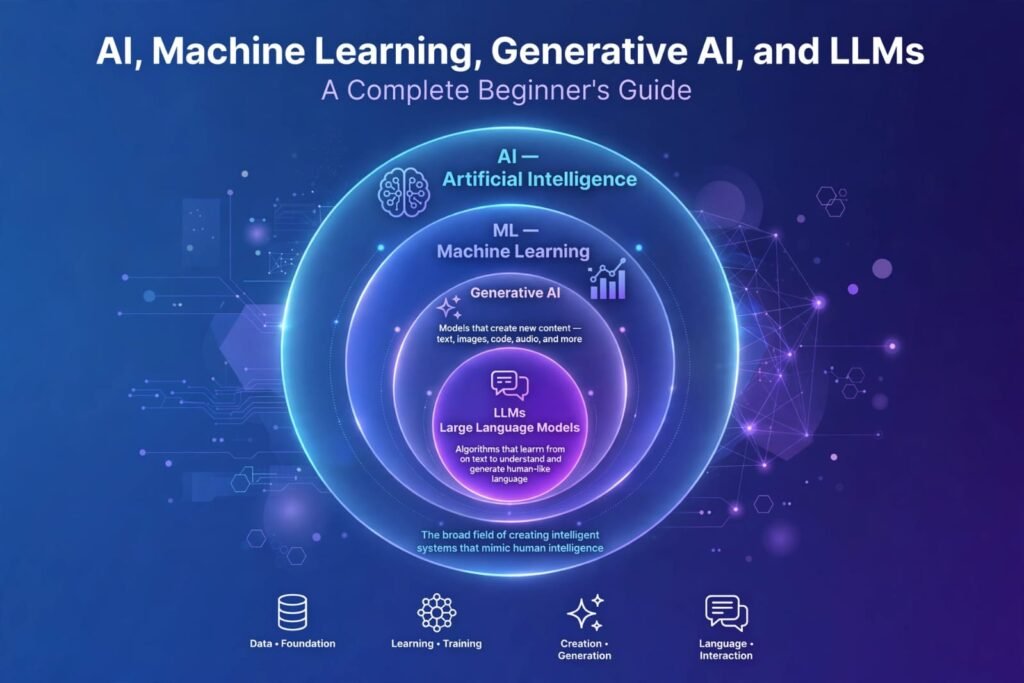
AI Concepts: The Big Picture
One of the easiest ways to understand the relationship between these technologies is to imagine a hierarchy.
Artificial Intelligence
Artificial Intelligence is the broad field.
↓
Machine Learning
Machine learning is one approach used to create AI systems.
↓
Deep Learning
Deep learning is a machine-learning approach based on multi-layer neural networks.
↓
Generative AI
Generative AI refers to systems capable of generating new content.
↓
Large Language Models
LLMs are a class of models designed to process and generate language and can power many generative-AI applications.
Not every AI system is a machine-learning system.
Not every machine-learning system is a deep-learning system.
Not every AI system is generative.
And not every generative-AI system is an LLM.
Understanding these distinctions makes the broader AI landscape much easier to understand.
The Difference Between AI, ML, Generative AI, and LLMs
Let’s summarize the four major concepts.
Artificial Intelligence
AI is the broadest concept.
It refers to technologies designed to perform tasks associated with intelligence.
Machine Learning
ML is a subset of AI.
It involves systems learning patterns from data.
Generative AI
Generative AI focuses on producing new content.
It can generate text, images, audio, video, code, and other outputs.
Large Language Models
LLMs are AI models designed around language.
They can power conversational applications, writing tools, coding assistants, research tools, and other applications.
A simple analogy is:
AI = the large field
ML = one major approach within that field
Generative AI = systems that generate content
LLMs = language-focused models that can power generative applications
How These Technologies Work Together
Imagine an online customer-support platform.
The platform could use:
Machine Learning
To classify incoming customer requests.
NLP
To understand the language in those requests.
LLM
To generate a response draft.
RAG
To retrieve information from the company’s knowledge base.
AI Automation
To route the request to the appropriate team.
Human Review
To handle sensitive or complex cases.
This example demonstrates that modern AI applications are often combinations of multiple technologies.
Why AI Terminology Matters
Understanding terminology is important because AI discussions often use similar-sounding words to describe different technologies.
For example:
Someone may say:
“AI wrote this article.”
That statement could mean the person used:
- An LLM
- A writing application
- A chatbot
- An AI-powered editor
- A content-generation workflow
Another person may say:
“We use machine learning.”
That could refer to:
- Fraud detection
- Recommendation systems
- Forecasting
- Image classification
- Customer segmentation
Knowing the terminology helps you ask better questions and choose appropriate tools.
How AI Is Changing the Way People Work
AI is changing many workflows.
Instead of manually completing every step, professionals can increasingly use AI to assist with parts of a process.
For example:
Traditional Content Workflow
Research → Outline → Draft → Edit → Publish
AI-Assisted Workflow
Research → AI-assisted research → Outline → AI-assisted draft → Human editing → Fact checking → Publish
The second workflow can potentially reduce the time spent on repetitive activities.
However, human judgment remains important.
AI-generated output should be reviewed before publication, particularly when accuracy, reputation, legal issues, financial decisions, or safety are involved.
AI and Human Creativity
AI has created a major discussion around creativity.
AI systems can generate:
- Ideas
- Images
- Stories
- Music
- Designs
- Marketing copy
But human creativity includes more than generating an output.
It also involves:
- Purpose
- Experience
- Taste
- Context
- Emotion
- Judgment
- Strategy
A useful way to think about generative AI is as a creative tool.
A photographer uses a camera.
A designer uses design software.
A writer uses editing tools.
An AI system can become another tool in the creative workflow.
How Beginners Should Use AI
If you are new to AI, start small.
Instead of trying to learn dozens of tools, choose one AI application and experiment with it.
For example:
Day 1
Learn what AI means.
Day 2
Learn machine learning.
Day 3
Learn Generative AI.
Day 4
Learn LLMs.
Day 5
Practice writing prompts.
Day 6
Use AI for a real task.
Day 7
Review the results and identify errors.
Then repeat the process with increasingly complex tasks.
Practical experience is one of the best ways to understand AI.
Questions Beginners Commonly Ask
Is AI the same as ChatGPT?
No.
ChatGPT is an AI application that can use large language models and other technologies.
AI is the broader field.
Is ChatGPT an LLM?
The relationship is more nuanced than simply saying “ChatGPT equals an LLM.” ChatGPT is a product/application that can use language models along with other components and capabilities.
Is Generative AI the same as AI?
No.
Generative AI is a category within the broader AI field.
Is Machine Learning AI?
Yes, machine learning is generally considered a subfield of AI.
Do I need coding skills to learn AI?
No.
Beginners can learn AI concepts and use AI tools without becoming programmers.
However, coding can become valuable if you want to build AI applications or work technically with models.
Do I need mathematics to understand AI?
Basic AI concepts can be learned without advanced mathematics.
If you want to study machine learning technically, mathematics becomes increasingly important.
Can AI make mistakes?
Yes.
AI systems can produce incorrect, incomplete, biased, or unsupported outputs.
Should I trust everything AI says?
No.
Important information should be verified.
The Future of AI
AI technology continues to evolve rapidly.
Future AI systems may become increasingly capable in areas such as:
- Multimodal interaction
- Automation
- Software development
- Research assistance
- Personal productivity
- Robotics
- Business intelligence
- Education
- Creative production
At the same time, important challenges remain.
These include:
- Accuracy
- Privacy
- Security
- Bias
- Copyright
- Safety
- Governance
- Human oversight
The future of AI is therefore not only about making models more capable.
It is also about learning how to use those capabilities responsibly.
Final Thoughts
Artificial Intelligence is a broad field, and understanding its terminology is the first step toward becoming comfortable with the technology.
The most important concepts to remember are:
AI is the broad field of creating systems capable of performing tasks associated with intelligence.
Machine Learning is an approach where systems learn patterns from data.
Deep Learning uses multi-layer neural networks and has become important for modern AI applications.
Generative AI creates new content such as text, images, audio, video, and code.
Large Language Models are language-focused AI models that can understand and generate text and can power many conversational and content-generation applications.
Around these concepts are dozens of additional terms, including:
- Prompts
- Tokens
- Parameters
- Training
- Inference
- Fine-tuning
- RAG
- Hallucinations
- AI agents
- Multimodal AI
- Computer vision
- NLP
- Reinforcement learning
- AI automation
You do not need to memorize every term immediately.
Start with the fundamentals.
Learn one concept at a time.
Use AI tools.
Experiment with prompts.
Verify important information.
Then gradually move into more advanced topics.
AI is a large field, but beginners do not need to understand everything on day one.
The best starting point is simply to understand the basic concepts, learn the vocabulary, and begin experimenting responsibly.
Once you understand the difference between AI, Machine Learning, Generative AI, and LLMs, the rest of the AI ecosystem becomes much easier to understand.
And that foundation can help you explore AI for digital marketing, content creation, SEO, business, productivity, education, automation, and many other areas.
The goal is not simply to know what AI is. The goal is to understand how it works, where it can help, where it can fail, and how you can use it effectively.