
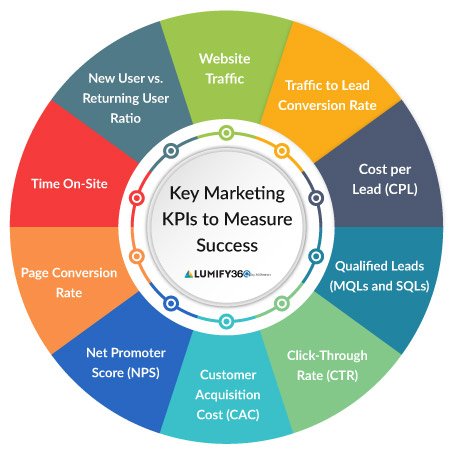
Marketing KPIs: The Complete Guide to 50+ Key Marketing Metrics Every Marketer Should Track
Introduction Marketing is no longer about simply publishing advertisements, posting on social media, or creating blog content and hoping that customers will respond. Modern marketing is increasingly data-driven. Businesses need to know what is working, what is not working, where customers are coming from, how much marketing activities cost, and whether those activities are contributing to business growth. This is where Marketing KPIs become important. Marketing KPIs help businesses measure performance using specific, trackable indicators. They can help marketers understand website traffic, engagement, leads, conversions, customer acquisition costs, revenue, advertising performance, email campaigns, SEO, social media, and many other areas. However, there is one important point to understand: Not every marketing metric is a KPI. A metric becomes a useful KPI when it is connected to an important business or marketing objective. For example, website traffic can be useful, but traffic alone does not necessarily mean that a business is growing. If a website receives thousands of visitors but generates very few qualified leads or sales, the business may need to investigate why. Similarly, a social media post may receive thousands of likes, but if the business objective is generating qualified leads, likes alone may not tell the complete story. The purpose of this guide is to explain Marketing KPIs in simple language and show how marketers can use them to make better data-informed decisions. What Are Marketing KPIs? KPI stands for Key Performance Indicator. A Marketing KPI is a measurable value used to evaluate whether a marketing activity or strategy is achieving a specific objective. In simple words: Marketing KPIs help you measure whether your marketing efforts are moving toward your goals. For example, suppose a company wants to generate 500 qualified leads in three months. The company could track: Number of leads Qualified leads Cost per lead Lead conversion rate Landing page conversion rate Customer acquisition cost Lead-to-customer rate These measurements help marketers understand how effectively their marketing strategy is performing. Why Are Marketing KPIs Important? Marketing without measurement can become difficult to manage. KPIs provide a framework for understanding performance. 1. KPIs Help Measure Progress Suppose your goal is to increase website leads by 30%. Without a KPI, you may not know whether you are getting closer to that goal. Lead volume and conversion rate can provide measurable indicators of progress. 2. KPIs Help Identify Problems Imagine your website traffic has increased significantly, but sales have not increased. That could indicate problems with: Website conversion Product positioning Pricing Landing pages Audience targeting Lead quality Sales follow-up KPIs can help identify where further investigation is needed. 3. KPIs Help Allocate Marketing Budgets Businesses often have limited marketing budgets. Performance data can help marketers understand which campaigns, channels, and activities are producing useful results. For example, a company may compare: SEO Google Ads Meta Ads Email marketing Content marketing Social media The goal is not simply to find the channel with the cheapest click. The goal is to understand which activities contribute to meaningful business outcomes. 4. KPIs Support Better Decision-Making Marketing teams can use KPI data to test assumptions and make decisions based on evidence. Instead of saying: “This campaign feels successful.” You can ask: “Did this campaign generate qualified leads at an acceptable cost?” That is a much more useful business question. KPI vs Metric: What Is the Difference? The terms metric and KPI are sometimes used interchangeably, but they are not exactly the same. A metric is a measurable data point. A KPI is a metric that has been selected because it is particularly important for evaluating progress toward a specific objective. For example: Metrics: Website sessions Page views Likes Impressions Clicks Possible KPIs: Qualified leads Revenue generated Customer acquisition cost Conversion rate Return on advertising spend The same metric can be important in one situation and less important in another. How to Choose the Right Marketing KPIs Choosing KPIs should begin with your goals. A simple framework is: Business Goal → Marketing Objective → KPI → Target → Measurement → Optimization For example: Business Goal: Increase revenue Marketing Objective: Generate more qualified customers KPIs: Qualified leads Lead-to-customer rate Customer acquisition cost Revenue Marketing ROI This approach keeps measurement connected to business outcomes. SMART Marketing Goals Marketing KPIs work better when goals are clearly defined. One common framework is SMART: Specific Measurable Achievable Relevant Time-bound Instead of: “Increase website traffic.” A clearer goal might be: “Increase organic website sessions by 25% over the next six months.” Now you have a specific objective and a measurable timeframe. The Most Important Marketing KPI Categories Marketing KPIs can be divided into several categories: Awareness KPIs Website KPIs SEO KPIs Content marketing KPIs Social media KPIs Paid advertising KPIs Lead generation KPIs Conversion KPIs Email marketing KPIs E-commerce KPIs Customer KPIs Revenue KPIs ROI and profitability KPIs Let’s examine each category. Part 1: Brand Awareness KPIs Brand awareness KPIs measure how effectively marketing activities are helping people discover and recognize a business. 1. Impressions An impression represents an instance in which content or an advertisement is displayed. For example, if an advertisement is displayed 10,000 times, it can generate 10,000 impressions. Impressions help measure exposure. However, impressions alone do not tell you whether people engaged with the advertisement or became customers. 2. Reach Reach represents the number of unique people who were exposed to content or advertising within a particular measurement context. Reach is different from impressions. For example: Reach: 5,000 people Impressions: 12,000 This could mean that the content was shown multiple times to some users. 3. Brand Search Volume Brand search volume measures how often people search for your brand name or branded terms. An increase in branded searches can sometimes indicate increased awareness, although it should be interpreted alongside other data. For example, a business may track searches for: Company name Product name Brand + service Brand + location 4. Share of Voice Share of voice attempts to measure how visible your brand is compared with competitors within a defined market, channel, or advertising environment. It