
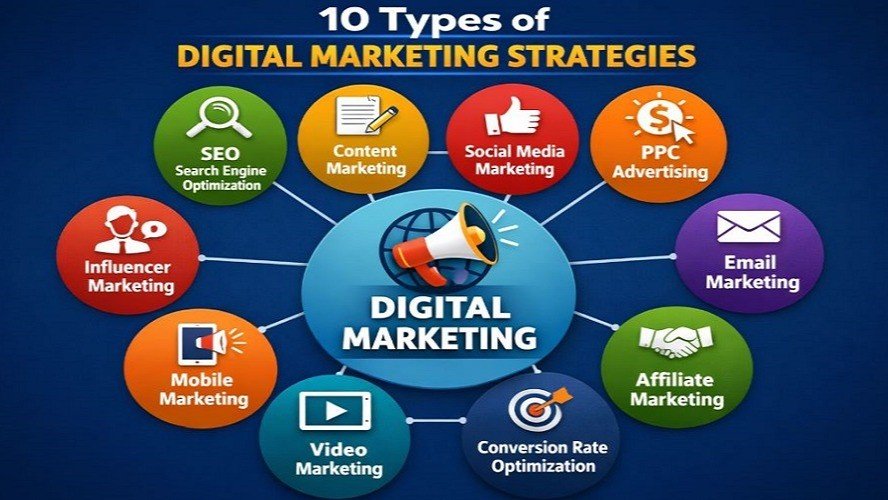
In today’s digital world, simply having a website or posting regularly on social media is not enough to grow a business. To achieve meaningful results online, businesses need a clear and well-planned digital marketing strategy.
A digital marketing strategy helps you decide who your target audience is, what goals you want to achieve, which marketing channels you should use, what type of content you should create, how much you should spend, and how you will measure your results.
Whether you are a beginner, small business owner, freelancer, blogger, startup founder, or aspiring digital marketer, learning how to create a digital marketing strategy is an essential skill.
In this guide, you will learn what a digital marketing strategy is, why it matters, and how to create one step by step.
What Is a Digital Marketing Strategy?
A digital marketing strategy is a structured plan that uses digital channels and marketing techniques to achieve specific business goals.
Digital marketing channels can include:
- Search engines
- Websites
- Social media
- Email marketing
- Online advertising
- Content marketing
- Video platforms
- Mobile applications
The purpose of a digital marketing strategy depends on the business. Common goals include:
- Increasing brand awareness
- Generating website traffic
- Getting more leads
- Increasing sales
- Building an online audience
- Improving customer retention
- Increasing brand visibility
Simple Example
Imagine that you run a digital marketing agency.
Your marketing strategy might look like this:
SEO → Website Traffic → Helpful Content → Lead Form → Consultation → Customer
In this example, every marketing activity supports a larger business objective.
Why Is a Digital Marketing Strategy Important?
Without a strategy, businesses may publish random social media posts, run advertisements without clear objectives, or create content without understanding their audience.
A well-planned strategy gives your marketing activities direction.
1. Helps You Set Clear Goals
A strategy helps you define exactly what you want to achieve through digital marketing.
2. Helps You Reach the Right Audience
Audience research allows you to create content and campaigns that are relevant to potential customers.
3. Helps You Manage Your Budget
A strategy helps you decide how much to invest in SEO, content marketing, social media, advertising, and other activities.
4. Makes Performance Easier to Measure
You can use analytics and KPIs to understand whether your marketing activities are producing the desired results.
5. Creates Consistency
A strategy helps you maintain a consistent approach across your website, social media channels, email campaigns, and advertising.
Step 1: Define Your Business Goals
The first step in creating a digital marketing strategy is to define your goals.
Ask yourself:
What do I want to achieve through digital marketing?
Your goals could include:
- Increasing website traffic
- Generating more leads
- Increasing online sales
- Building brand awareness
- Growing an email list
- Attracting local customers
- Increasing product or service inquiries
Try to make your goals specific and measurable.
Instead of saying:
“I want to grow my website.”
You could create a more specific goal such as:
“I want to increase organic website traffic over the next six months.”
A clear goal makes it easier to track progress and evaluate performance.
Step 2: Identify Your Target Audience
Your marketing strategy becomes much more effective when you understand who you are trying to reach.
Your target audience may be defined by factors such as:
- Age
- Location
- Profession
- Interests
- Needs
- Problems
- Buying behavior
- Income range
- Preferred platforms
Example
Suppose you provide graphic design services.
Your potential target audience could include:
- Small business owners
- Startups
- Bloggers
- E-commerce businesses
- Local businesses
- Content creators
Understanding your audience helps you create more relevant content, offers, and advertising campaigns.
Step 3: Create a Buyer Persona
A buyer persona is a research-based profile representing an ideal customer.
For example:
Buyer Persona
Name: Rahul
Age: 28
Profession: Small Business Owner
Location: Delhi NCR
Main Problem: Not getting enough website traffic or leads
Goal: Increase online customers
Preferred Platforms: Google, Instagram, and YouTube
A buyer persona helps you understand the type of person you are creating your marketing for.
If your business serves multiple customer groups, you can create more than one buyer persona.
Step 4: Analyze Your Competitors
Competitor research is another important part of a digital marketing strategy.
Analyze your competitors’:
- Websites
- Blog content
- SEO strategies
- Social media profiles
- Content formats
- Advertising campaigns
- Offers
- Customer reviews
- Keywords
- Landing pages
The goal is not to copy your competitors.
Instead, competitor research helps you understand the market and identify opportunities.
Questions to Ask
- What topics are competitors writing about?
- What keywords are they targeting?
- Which social platforms are they using?
- What type of content receives engagement?
- What problems are they solving?
- Are there topics they are not covering?
- How can you provide more useful information?
This research can help you develop a stronger content and marketing plan.
Step 5: Choose the Right Digital Marketing Channels
You do not need to be active on every digital platform.
The right channels depend on your audience, business goals, resources, and industry.
Some major digital marketing channels include:
Search Engine Optimization
SEO helps businesses improve their visibility in organic search results.
Content Marketing
Content marketing uses useful and relevant content to attract and educate an audience.
Social Media Marketing
Social media can help businesses build awareness, engage audiences, and promote products or services.
Email Marketing
Email marketing allows businesses to communicate with subscribers and customers.
Paid Advertising
Platforms such as Google Ads and Meta Ads can help businesses reach targeted audiences through paid campaigns.
Local Marketing
Local businesses can use digital channels to improve visibility among customers in specific geographic areas.
Choose channels based on where your target audience is and what your business can consistently manage.
Step 6: Build an SEO Strategy
SEO can be an important part of a digital marketing strategy, especially for businesses that want to build long-term organic visibility.
An SEO strategy can include:
- Keyword research
- Search intent analysis
- Content planning
- On-page SEO
- Internal linking
- Technical SEO
- Link building
- Performance monitoring
Keyword Research
Start by identifying the terms your target audience searches for.
For example:
- Digital marketing for beginners
- SEO tips for small businesses
- Social media marketing strategy
- Best digital marketing tools
Do not focus only on search volume. Relevance and search intent are also important.
Your goal should be to create content that genuinely satisfies what users are looking for.
Step 7: Create a Content Marketing Strategy
Content marketing is one of the most important components of modern digital marketing.
You can create different types of content, including:
- Blog posts
- Videos
- Infographics
- Tutorials
- Case studies
- E-books
- Guides
- Social media posts
- Newsletters
- Checklists
Create Content Pillars
Content pillars help organize your website around important topics.
For a digital marketing blog, you could create four major pillars:
Pillar 1: Digital Marketing Fundamentals
Topics related to basic marketing concepts and terminology.
Pillar 2: SEO
Topics covering keyword research, on-page SEO, technical SEO, and organic traffic.
Pillar 3: Social Media and Content Marketing
Topics covering social platforms, content creation, and audience engagement.
Pillar 4: Paid Advertising and Analytics
Topics covering Google Ads, Meta Ads, analytics, KPIs, and conversion optimization.
This structure can help you build a more organized content library.
Step 8: Develop a Social Media Strategy
Simply posting every day is not a complete social media strategy.
You should define:
- Your target platform
- Your audience
- Content types
- Posting frequency
- Brand voice
- Marketing goals
- Engagement strategy
- Performance metrics
Different platforms may require different content approaches.
You can focus on:
- Industry insights
- Educational posts
- Professional tips
- Case studies
- Business content
You can use:
- Reels
- Carousels
- Short tutorials
- Visual tips
- Stories
YouTube
You can create:
- Tutorials
- Educational videos
- Reviews
- How-to guides
- Long-form content
Choose formats that fit both your audience and your available resources.
Step 9: Create a Paid Advertising Strategy
Paid advertising can help businesses reach targeted audiences and generate traffic, leads, or sales.
Common advertising platforms include:
- Google Ads
- Meta Ads
- LinkedIn Ads
- YouTube advertising
Before launching a campaign, define the following:
Campaign Goal
Do you want traffic, leads, sales, awareness, or another measurable result?
Target Audience
Who should see your advertisements?
Budget
How much are you willing to spend?
Ad Creative
What message, image, video, or offer will you present?
Landing Page
Where will users go after clicking the advertisement?
Measurement
Which metrics will determine campaign performance?
A campaign should have a clear objective before you start spending money.
Step 10: Build a Conversion Funnel
Getting visitors to your website is only one part of digital marketing.
You also need a process for moving visitors toward a desired action.
A simple marketing funnel looks like this:
Awareness → Interest → Consideration → Conversion → Retention
Awareness
The customer discovers your brand for the first time.
Interest
The customer becomes interested in your product, service, or content.
Consideration
The customer compares options and evaluates your solution.
Conversion
The customer takes a desired action, such as purchasing a product or submitting a form.
Retention
The business works to maintain the customer relationship.
Understanding this journey can help you create appropriate content for different stages.
Step 11: Create Effective Landing Pages
A landing page is often an important part of a lead-generation or advertising campaign.
A good landing page can include:
- A clear headline
- Strong value proposition
- Relevant information
- Benefits
- Trust signals
- Testimonials where appropriate
- A clear call to action
- A simple form
For example:
Get Your Free Digital Marketing Consultation
The landing page should match the message of the advertisement or content that brought the visitor there.
Step 12: Set a Digital Marketing Budget
Your digital marketing budget depends on your business size, industry, goals, resources, and chosen channels.
You may allocate your budget toward:
- SEO
- Content creation
- Social media
- Paid advertising
- Email marketing
- Marketing tools
- Graphic design
- Video production
Beginners should avoid spending large amounts without knowing what they are measuring.
Start with manageable campaigns, measure the results, and use the data to make future decisions.
Step 13: Track Important KPIs
A digital marketing strategy should always include measurement.
Important KPIs may include:
Website Traffic
Measures the number of visitors coming to your website.
Organic Traffic
Measures visitors coming from unpaid search results.
Leads
Measures potential customers generated through your marketing efforts.
Conversion Rate
Measures the percentage of visitors who complete a desired action.
Click-Through Rate
Measures how frequently people click after seeing an ad, link, or search result.
Cost Per Click
Measures the average cost of an advertising click.
Customer Acquisition Cost
Measures the average cost of acquiring a new customer.
Return on Ad Spend
Measures revenue attributed to advertising compared with advertising spend.
Choose KPIs that directly relate to your business goals.
Step 14: Use Analytics and Tracking
Data helps you understand what is happening on your website and across your marketing campaigns.
Analytics can provide information about:
- Website visitors
- Traffic sources
- User engagement
- Conversions
- Campaign performance
- Search performance
- Customer journeys
For example, if you are running a lead-generation campaign, do not measure only clicks.
Also track:
- Form submissions
- Qualified leads
- Cost per lead
- Sales generated
This gives you a better understanding of actual business performance.
Step 15: Test and Optimize Your Strategy
Digital marketing is not a one-time process.
Your strategy should continuously evolve based on performance data.
You can test:
- Headlines
- Ad copy
- Images
- Videos
- CTAs
- Landing pages
- Content formats
- Email subject lines
- Audience segments
Example
You could test two CTA buttons:
Version A: Get Started
Version B: Book Your Free Consultation
Then compare their performance using a predefined metric.
This process is commonly known as A/B testing.
Common Digital Marketing Strategy Mistakes
Beginners often make several mistakes when developing their marketing strategies.
1. Not Defining a Clear Goal
If you do not know what you want to achieve, measuring success becomes difficult.
2. Trying to Use Every Platform
Being everywhere can spread your time and resources too thin.
Focus on the channels that are most relevant to your audience and goals.
3. Ignoring Audience Research
Without understanding your audience, your content may not address their actual problems or needs.
4. Focusing Only on Traffic
More traffic does not automatically mean more customers.
You should also consider leads, conversions, revenue, and other business outcomes.
5. Ignoring Analytics
Without tracking data, it becomes difficult to understand what is working.
6. Being Inconsistent
Digital marketing usually requires consistent effort. Publishing content once and then disappearing for several months can make it harder to build momentum.
7. Expecting Immediate Results
Different channels can have different timelines. SEO and content marketing, for example, may require sustained effort before meaningful results become visible.
Digital Marketing Strategy Example
Let’s consider a simple example.
Imagine a local digital marketing agency wants to generate more leads online.
Goal
Generate more qualified leads from the agency website.
Target Audience
Small businesses that need digital marketing services.
SEO Strategy
Create service pages and educational blog content targeting relevant search topics.
Content Strategy
Publish one high-quality educational article every week.
Social Media Strategy
Share short marketing tips, case studies, videos, and educational posts.
Paid Advertising
Run targeted search or social advertising campaigns with dedicated landing pages.
Conversion Strategy
Use contact forms, consultation offers, and clear calls to action.
Measurement
Track:
- Website traffic
- Leads
- Conversion rate
- Cost per lead
- Sales
- Revenue
Optimization
Review the results regularly and improve campaigns based on the data.
A Simple Digital Marketing Strategy Framework
If you are a complete beginner, use this simple framework:
Step 1: Define your business goal
↓
Step 2: Identify your target audience
↓
Step 3: Create buyer personas
↓
Step 4: Research your competitors
↓
Step 5: Choose your marketing channels
↓
Step 6: Research keywords and content topics
↓
Step 7: Create useful content
↓
Step 8: Launch campaigns
↓
Step 9: Track KPIs
↓
Step 10: Analyze results
↓
Step 11: Test and optimize
↓
Step 12: Repeat the process
This approach can help you move from random marketing activities to a structured digital marketing system.
Final Thoughts
A successful digital marketing strategy is more than posting on social media or running advertisements. It is a complete plan that connects your business goals, target audience, content, SEO, social media, paid advertising, conversion strategy, and analytics.
If you are just starting, do not try to master every digital marketing channel at once.
Start with the fundamentals. Define your audience, choose a few relevant channels, create useful content, set measurable goals, and track your performance.
The most useful mindset for beginners is:
Learn → Plan → Execute → Measure → Optimize → Repeat
Digital marketing is constantly evolving, but strong fundamentals remain valuable. By developing a clear strategy and improving it based on real data, you can build a more organized, measurable, and sustainable approach to online marketing.
Remember: Strategy gives your marketing direction, content attracts your audience, and measurement shows you what to improve.
Pingback: Google Ads for Beginners: A Complete Guide to Google Advertising - raghudigitalhub.com
Pingback: Lead Generation: A Complete Beginner’s Guide to Getting More Customers - raghudigitalhub.com