
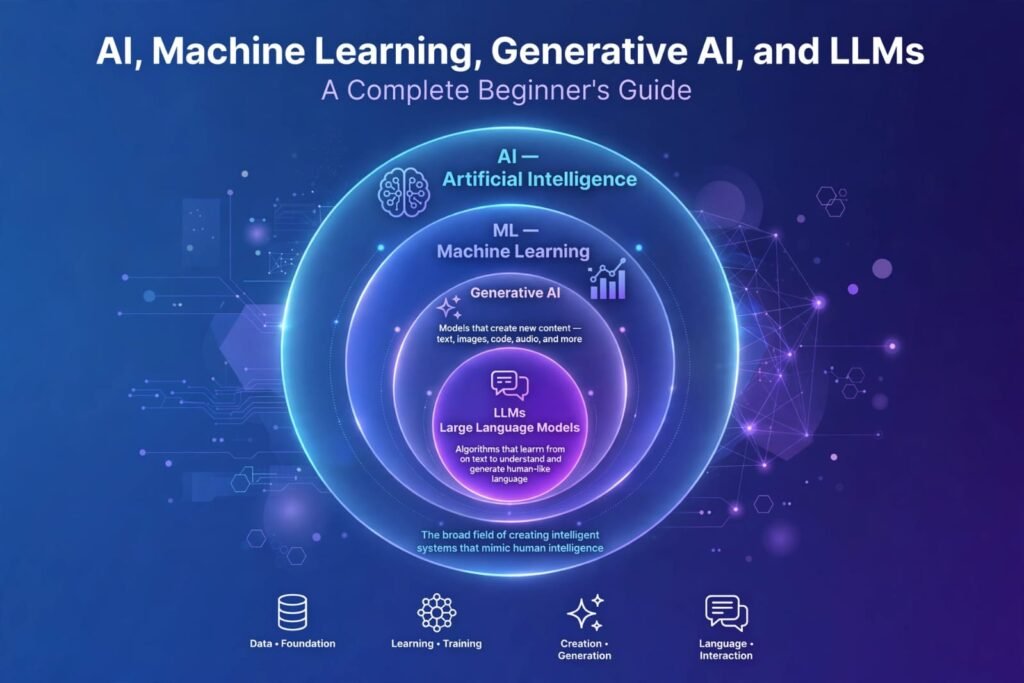
What Is AI, Machine Learning, Generative AI, and LLMs? A Complete Beginner’s Guide
Artificial Intelligence has become one of the most important technologies of the modern digital world. From search engines and recommendation systems to chatbots, self-driving technologies, image generators, business automation, and digital assistants, AI is increasingly becoming part of everyday life. However, for someone who is just starting to learn about artificial intelligence, the terminology can be confusing. You may have heard terms such as Artificial Intelligence (AI), Machine Learning (ML), Deep Learning, Generative AI, Large Language Models (LLMs), Natural Language Processing (NLP), neural networks, prompts, tokens, AI models, training data, and automation. What do all these terms mean? Are AI and Machine Learning the same thing? Is ChatGPT an AI or an LLM? What exactly is Generative AI? How does an AI model learn? What is a prompt? What are tokens? This complete beginner’s guide explains these concepts in simple language. By the end of this article, you should have a much clearer understanding of the AI ecosystem and the terminology used in modern artificial intelligence. Table of Contents What Is Artificial Intelligence? How Does AI Work? Examples of AI in Everyday Life Types of Artificial Intelligence What Is Machine Learning? How Machine Learning Works Types of Machine Learning What Is Deep Learning? What Are Neural Networks? AI vs Machine Learning vs Deep Learning What Is Generative AI? How Generative AI Works Examples of Generative AI What Are Large Language Models? How LLMs Work Chatbots vs LLMs What Is Natural Language Processing? What Is Computer Vision? What Is an AI Model? What Is Training Data? What Is a Dataset? What Is an Algorithm? What Is a Prompt? What Is Prompt Engineering? What Are Tokens? What Are Parameters? What Is an AI Inference? What Is Fine-Tuning? What Is RAG? What Are AI Hallucinations? What Is an AI Agent? What Is AI Automation? What Is an AI API? What Is an AI Assistant? What Is Multimodal AI? What Is Speech Recognition? What Is Text-to-Speech? What Is Image Generation? What Is AI Video Generation? What Is Reinforcement Learning? What Is Reinforcement Learning From Human Feedback? What Is Supervised Learning? What Is Unsupervised Learning? What Is Classification? What Is Regression? What Is Clustering? What Is Computer-Generated Content? AI Bias AI Safety AI Ethics AI Privacy AI Security Responsible AI AI vs Automation AI vs Traditional Software Benefits of AI Limitations of AI Common AI Myths AI in Digital Marketing AI in Business AI in Education AI in Healthcare AI in Finance AI in Customer Service AI in Content Creation AI in SEO AI Skills for Beginners How Beginners Can Start Learning AI AI Terminology Cheat Sheet Conclusion 1. What Is Artificial Intelligence? Artificial Intelligence, commonly called AI, is a field of computer science focused on creating computer systems that can perform tasks that normally require some form of human intelligence. These tasks can include: Understanding language Recognizing images Identifying patterns Making predictions Solving problems Generating content Making recommendations Understanding speech Supporting decision-making Interacting with users In simple terms: AI is technology that enables computers to perform tasks that appear intelligent. For example, when a navigation application recommends the fastest route, an AI-powered recommendation system suggests a movie, or a chatbot answers a question, artificial intelligence may be involved. AI does not necessarily mean that a computer thinks exactly like a human. Instead, AI systems are designed to perform particular tasks using algorithms, data, models, and computational resources. 2. How Does AI Work? At a basic level, an AI system works by using: Data + Algorithms + Computing Power + Models = AI System Data provides information. Algorithms provide methods for processing that information. Computing power allows systems to perform large numbers of calculations. Models represent patterns learned from data. Consider an AI system designed to recognize cats in photographs. The system may be trained using thousands or millions of images containing cats and other objects. During training, the model learns statistical patterns associated with cats. Later, when a new photograph is provided, the system analyzes the image and generates a prediction. The important point is that the AI system generally does not memorize one simple definition of a cat. Instead, it learns patterns from examples. 3. Examples of AI in Everyday Life You may already use AI every day without realizing it. Search Engines Search engines use sophisticated algorithms and machine-learning systems to understand queries and return relevant information. Recommendation Systems Streaming services, shopping websites, and social platforms can recommend content based on patterns in user behavior. Smartphones Modern smartphones use AI for features such as: Face recognition Voice assistants Camera enhancement Spam detection Predictive text Email Email platforms can use AI to identify spam, categorize messages, and assist with writing. Maps Navigation systems can analyze traffic and other information to estimate travel times and recommend routes. Customer Service Businesses increasingly use AI-powered chatbots to answer frequently asked questions. Content Creation Generative AI systems can help users create: Articles Images Videos Audio Presentations Code AI is therefore not limited to robots or science-fiction applications. It is already integrated into many ordinary digital experiences. 4. Types of Artificial Intelligence AI can be categorized in several different ways. One common conceptual classification is: Artificial Narrow Intelligence Artificial Narrow Intelligence, often called narrow AI, refers to systems designed to perform specific tasks. Examples include: Spam filters Recommendation systems Image classifiers Translation systems Voice recognition systems Most AI systems used today fall into this broad category. Artificial General Intelligence Artificial General Intelligence, or AGI, generally refers to a hypothetical form of AI capable of performing a broad range of intellectual tasks at a level comparable to humans or beyond. AGI remains a major topic of research and debate. Artificial Superintelligence Artificial Superintelligence is a hypothetical concept describing an AI system whose general intellectual capabilities substantially exceed those of humans. It is largely discussed as a future or theoretical possibility rather than an established technology. 5. What Is Machine Learning? Machine Learning, commonly abbreviated as ML, is a subfield of artificial intelligence. Instead of explicitly programming every
What Is AI, Machine Learning, Generative AI, and LLMs? A Complete Beginner’s Guide Read More »