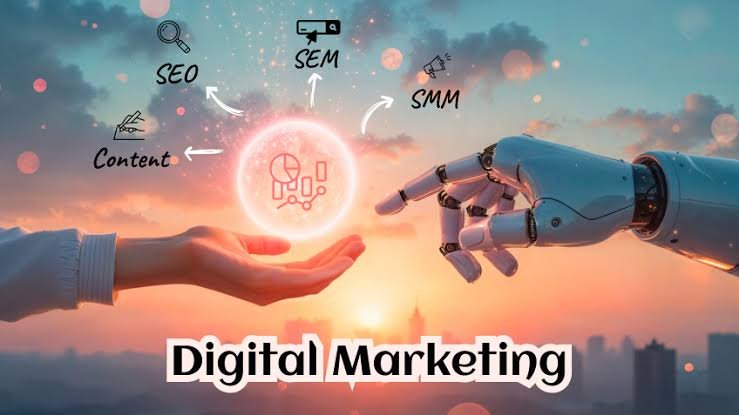
AI in Digital Marketing: The Complete Guide to Artificial Intelligence in Digital Marketing
Introduction Artificial Intelligence, commonly known as AI, is changing the way businesses approach digital marketing. From content creation and search engine optimization to social media, advertising, email marketing, customer service, analytics, and sales, AI is becoming an important technology across the modern marketing ecosystem. Digital marketing has always depended on data. Marketers need to understand what customers want, where they search for information, what content they consume, which advertisements attract attention, and what encourages people to purchase a product or service. The challenge is that the amount of available data has grown dramatically. Businesses can collect information from websites, search engines, social media platforms, advertising campaigns, email campaigns, CRM systems, e-commerce stores, and customer interactions. Analyzing all of this information manually can be difficult and time-consuming. This is where AI in digital marketing becomes valuable. AI can help marketers analyze information, identify patterns, generate content, automate repetitive tasks, personalize customer experiences, and support marketing decisions. Generative AI can also help create text, images, ideas, scripts, advertisements, and other forms of marketing content. However, AI is not simply about automating everything. Successful digital marketing still requires strategy, creativity, customer understanding, brand positioning, critical thinking, and human judgment. This comprehensive guide explains AI in digital marketing, including how it works, major applications, benefits, challenges, AI tools, SEO, social media, advertising, email marketing, content marketing, analytics, personalization, automation, lead generation, e-commerce, local marketing, and the future of AI-powered marketing. 1. What Is AI in Digital Marketing? AI in digital marketing means using Artificial Intelligence technologies to support, automate, analyze, and improve digital marketing activities. AI systems can process large amounts of information and identify patterns that may be difficult to discover manually. Depending on the technology, AI can help marketers: Research customers Analyze marketing data Generate content Discover topics Research keywords Optimize campaigns Personalize messages Automate workflows Predict customer behavior Generate marketing ideas Analyze conversations Improve customer support Identify potential leads Traditional marketing software usually follows predefined instructions. AI-powered systems can go further by analyzing information and generating recommendations or content based on patterns and inputs. For example, a traditional automation system might send an email when someone fills out a form. An AI-powered system may analyze customer information and help determine what type of message, content, or follow-up may be relevant. This distinction is one reason AI has become increasingly important in digital marketing. 2. Why AI Is Becoming Important in Digital Marketing Digital marketing has become more complex. Businesses now communicate with customers through: Google Search Websites YouTube Instagram Facebook LinkedIn Email Mobile applications Online marketplaces Messaging platforms Paid advertising Every channel produces information. Marketers need to understand what is working and what is not. AI can help organize and analyze this information. Faster Data Analysis AI systems can process large amounts of data quickly. This can help marketers identify patterns in: Website traffic Search behavior Advertising performance Customer engagement Conversion activity Email campaigns Social media interactions Marketing Automation AI can support repetitive marketing workflows. Examples include: Email automation Customer segmentation Lead qualification Content recommendations Reporting Customer support Content Production Generative AI can help marketers create first drafts and ideas. This can reduce the time required for content production. Personalization AI can help businesses deliver more relevant experiences to different customer groups. Better Decision Support AI-generated insights can help marketers evaluate marketing data and identify potential opportunities. 3. How AI Works in Digital Marketing AI in digital marketing can involve several technologies. Machine Learning Machine learning allows computer systems to identify patterns in data and improve their predictions or classifications based on available information. Marketing applications can include: Customer segmentation Lead scoring Recommendation systems Forecasting Campaign analysis Natural Language Processing Natural Language Processing, or NLP, helps computers process human language. It is used in: Chatbots AI writing tools Search systems Customer support Sentiment analysis Text classification Generative AI Generative AI can produce new content based on instructions. It can assist with: Blog drafts Social media posts Email copy Advertising copy Product descriptions Video scripts Images Marketing ideas Predictive Analytics Predictive systems analyze historical and current information to estimate potential future outcomes. In marketing, predictive analytics can support: Lead scoring Customer retention analysis Demand forecasting Sales forecasting Campaign planning 4. AI in Content Marketing Content marketing is one of the most visible applications of AI. Marketers need to create content consistently, including: Blog posts Articles Social media posts Videos Emails Product descriptions Guides Case studies Landing pages AI can assist with almost every stage of content production. Content Ideation A marketer can provide a broad topic and ask AI to generate related content ideas. For example, a digital marketing website could build content around: SEO AI SEO Content marketing Social media marketing Google Ads Meta Ads Email marketing Marketing automation Lead generation AI can help organize these topics into categories. Content Outlines AI can create an initial structure for an article. For example: Introduction Definition Benefits Examples Strategies Tools Mistakes Best practices Future trends Conclusion A human writer can then improve the structure according to search intent and audience needs. Content Drafting Generative AI can create a first draft based on detailed instructions. However, marketers should not publish AI-generated content without review. A professional article should contain: Accurate information Original insights Useful examples Clear explanations Appropriate formatting Strong user value Content Repurposing One of the most useful applications of AI is repurposing. A long article can become: LinkedIn posts Instagram captions Short video scripts Email newsletters YouTube ideas Carousel content FAQ content This allows businesses to get more value from existing content. 5. AI and Search Engine Optimization SEO is another area where AI is becoming increasingly important. Search engines use sophisticated systems to understand content, queries, relevance, and user intent. Marketers can use AI to assist with SEO research and workflows. AI Keyword Research AI can help marketers discover: Related keywords Long-tail keywords Question-based keywords Topic clusters Search-intent variations For example, instead of targeting only “digital marketing,” a content strategy could include: What is digital marketing? Digital marketing strategies Digital