
AI Marketing Tools: How Artificial Intelligence Is Changing Digital Marketing
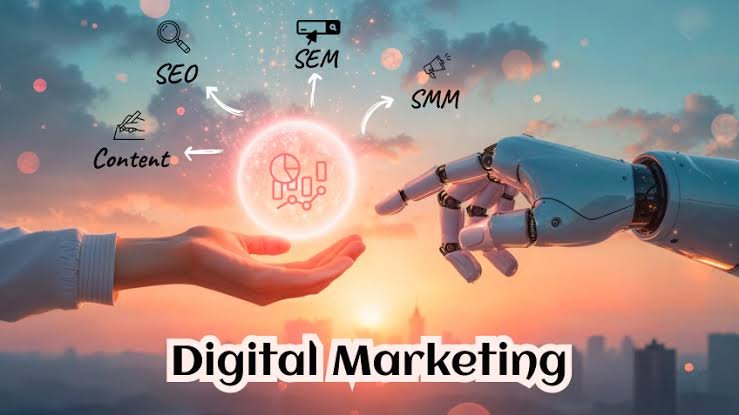
AI marketing tools are changing the way businesses plan, create, and optimize their digital marketing campaigns. From generating content and analyzing customer behavior to improving SEO and managing social media, artificial intelligence can help marketers save time and make data-driven decisions.
As digital competition continues to grow, businesses are increasingly using AI marketing tools to reach the right audience, create personalized experiences, and improve marketing performance.
What Are AI Marketing Tools?
AI marketing tools are software applications that use artificial intelligence, machine learning, natural language processing, and data analysis to automate or improve marketing tasks.
These tools can help marketers with activities such as:
- Content creation
- SEO and keyword research
- Social media management
- Email marketing
- Customer analysis
- Advertising optimization
- Graphic and video creation
- Marketing automation
- Data analysis
Instead of performing every task manually, marketers can use AI to speed up repetitive processes and focus more on strategy and creativity.
Why Are AI Marketing Tools Important?
Traditional marketing often requires significant time for research, content creation, analysis, and optimization. AI can assist with many of these activities.
Some major benefits include:
1. Saves Time
AI can help generate content ideas, social media captions, email drafts, ad copy, and keyword suggestions in a short amount of time.
2. Helps With Content Creation
AI writing tools can help marketers create blog outlines, product descriptions, social media posts, headlines, and marketing copy.
However, human editing is still important to ensure that content is accurate, useful, original, and aligned with the brand.
3. Supports SEO
AI-powered SEO tools can assist with keyword research, content optimization, competitor analysis, search intent, and technical SEO checks.
4. Improves Personalization
AI can analyze customer behavior and help businesses deliver more relevant content, recommendations, and marketing messages.
5. Data-Driven Marketing
AI can process large amounts of marketing data and identify patterns that may be difficult to discover manually.
Top AI Marketing Tools Marketers Should Know
There are many AI-powered platforms available for different marketing tasks. Here are some popular categories and examples.
1. ChatGPT – AI Content and Marketing Assistant
ChatGPT can assist with brainstorming, content outlines, blog drafts, social media ideas, email campaigns, ad copy, and marketing strategies.
It can also help marketers repurpose existing content into different formats.
2. Google Gemini – AI Research and Content Assistance
Google Gemini can help with brainstorming, research assistance, writing, summarization, and generating marketing ideas.
Marketers can use AI assistants like Gemini to speed up research and planning while verifying important information before publishing.
3. Canva – AI Design Tools
Canva combines design tools with AI-powered features that can help marketers create social media graphics, presentations, advertisements, thumbnails, and other visual content.
This can be especially useful for small businesses that need marketing designs without a large design team.
4. HubSpot – AI for Marketing Automation
HubSpot provides marketing, CRM, sales, and customer-service tools with AI capabilities. Marketers can use these features for content assistance, customer data, automation, and campaign workflows.
5. Semrush – AI and SEO Marketing
Semrush offers SEO, content marketing, competitor research, keyword research, and advertising tools. Its AI features can support marketers with content and search optimization workflows.
6. Grammarly – AI Writing Assistance
Grammarly can help improve writing by checking grammar, clarity, tone, and readability. Its AI features can also assist with rewriting and generating content.
How to Use AI Marketing Tools Effectively
Simply using AI does not automatically create a successful marketing campaign. The key is to combine AI with human strategy.
Step 1: Define Your Marketing Goal
Before using an AI tool, identify what you want to achieve.
For example:
- Increase website traffic
- Generate leads
- Improve SEO rankings
- Increase social media engagement
- Improve conversions
- Build brand awareness
Step 2: Choose the Right Tool
Different tools solve different problems. An SEO tool may be useful for keyword research, while a design platform may be better for creating social media graphics.
Step 3: Give Clear Instructions
The quality of AI output often depends on the information you provide. Include your target audience, industry, brand voice, goals, and content requirements.
Step 4: Review the Output
AI-generated content should be checked for accuracy, originality, tone, and relevance before publishing.
Step 5: Measure Results
Use analytics to understand whether your marketing activities are producing results. Monitor metrics such as traffic, engagement, leads, conversions, and return on investment.
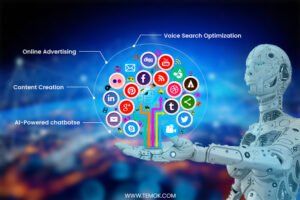
AI Marketing Tools for Different Tasks
| Marketing Task | Useful AI Tool Category |
|---|---|
| Blog writing | AI writing assistants |
| Keyword research | SEO platforms |
| Social media content | AI content and design tools |
| Graphic design | AI design platforms |
| Email marketing | Marketing automation platforms |
| Customer analysis | CRM and analytics tools |
| Ad copy | AI writing and advertising tools |
| SEO optimization | SEO and content optimization platforms |
| Video creation | AI video tools |
Advantages and Limitations of AI Marketing
AI offers several advantages, but marketers should also understand its limitations.
Advantages:
- Faster content production
- Automation of repetitive tasks
- Faster research and brainstorming
- Data analysis
- Personalized marketing
- Improved productivity
Limitations:
- AI can generate inaccurate information
- Content may require human editing
- AI does not replace marketing strategy
- Generic prompts can produce generic content
- Brand voice and creativity still require human direction
The Future of AI in Digital Marketing
AI is becoming an important part of modern digital marketing. As AI technology develops, marketers will likely use it more extensively for personalization, automation, customer analysis, content production, search optimization, and campaign management.
However, successful marketing will not simply be about using more AI tools. Businesses will need to combine technology with creativity, customer understanding, strong branding, and effective strategy.
Advantages of AI Digital Marketing
AI digital marketing provides several potential advantages for businesses and marketers.
Faster Content Production
AI can help marketers generate initial ideas and drafts quickly.
Automation
Repetitive marketing activities can be partially automated using AI-powered workflows.
Data Analysis
AI can process large amounts of marketing data and help identify patterns.
Personalization
Businesses can use customer information to create more relevant marketing experiences.
Improved Productivity
AI can allow marketers to spend less time on repetitive tasks and more time on strategy, creativity, and customer relationships.
Limitations of AI Digital Marketing
Although AI offers many opportunities, it also has limitations.
AI can sometimes generate inaccurate information, misunderstand context, or produce generic content.
Some important limitations include:
- AI can make factual errors
- Human editing is often required
- AI does not replace marketing strategy
- Generic prompts can produce generic results
- Brand creativity still requires human direction
- Important information should be verified
Therefore, successful AI digital marketing should combine artificial intelligence with human expertise.
The Future of AI Digital Marketing
The future of AI digital marketing will likely involve greater automation, personalization, data analysis, and AI-assisted content creation.
Businesses may increasingly use AI to understand customers, optimize campaigns, automate workflows, and improve marketing efficiency.
However, technology alone will not determine marketing success. Strong branding, creativity, customer understanding, useful content, and strategic thinking will remain important.
The marketers who learn how to combine AI tools with human creativity can develop more efficient marketing workflows.
Conclusion
AI marketing tools can help digital marketers work faster, analyze data, create content, improve SEO, and automate repetitive marketing activities. From AI writing assistants and SEO platforms to design and marketing automation tools, there are solutions for almost every part of the digital marketing process.
The best approach is to use AI as a marketing assistant rather than a complete replacement for human expertise. When AI technology is combined with human creativity, strategy, fact-checking, and customer understanding, businesses can build more efficient and effective digital marketing campaigns.
In short, AI is not replacing digital marketing—it is changing how digital marketing is done
Pingback: Best Ai marketing Tools - raghudigitalhub.com
Pingback: Digital Marketing Terminology Every Beginner Should Know - raghudigitalhub.com